Hoi An World Cultural Heritage Conservation Center
Preserving and Promoting the Value of Documentary Heritage of Hội An Ancient Town
Documentary heritage constitutes an important component of the cultural heritage of humanity. The term “documentary heritage” has been used in the Memory of the World Programme initiated by UNESCO in 1992.
It refers to documents and materials of exceptional value and long-term significance to communities, nations, and humanity, including texts, books, newspapers, drawings, diagrams, maps, musical scores, photographs, films, audio recordings, digital materials, etc., which reflect collective memory and human creativity across different historical periods.
According to the 2024 Law on Cultural Heritage of Vietnam, documentary heritage is defined as original informational content intentionally created by individuals or groups, directly expressed through symbols, codes, writing, drawings, sound, still or moving images, digital formats, or other forms on original carriers that are accessible and possess historical, cultural, scientific, or aesthetic value for at least one community, and are inherited and transmitted over time. To date, UNESCO has inscribed 570 documentary heritage collections in the Memory of the World Programme, of which Vietnam has 4 World Documentary Heritage items[1] and 7 Asia-Pacific Regional Documentary Heritage items[2].
Hội An, with its long-standing and vibrant cultural and historical development, was once one of the most bustling international trading ports in the region for several centuries and also served as the provincial capital of Quảng Nam for an extended period. Therefore, alongside its diverse and distinctive tangible and intangible cultural heritage systems, its documentary heritage is equally rich and remarkable. Survey and statistical results in recent years show that the richness and uniqueness of Hội An’s documentary heritage system lie not only in the diversity of material carriers (paper, wood, stone, metal, etc.), forms of expression (writing, drawing, carving, molding, inlaying, printing, etc.), types of materials (documents, books, newspapers, drawings, diagrams, photographs, films, etc.), and categories (genealogies, land registers, inscriptions, horizontal lacquered boards and parallel sentences, royal decrees, contracts, etc.), but also in the informational value of the content. Within this system, Hán Nôm documentary heritage is considered the most abundant and diverse component, providing significant information that helps clarify the historical and cultural values of monuments and sites, the lives and careers of individuals, as well as the history and cultural traditions of communities and of Hội An as an international trading port.
Recognizing the importance and significance of Hội An’s documentary heritage system, over the past decades, the work of collecting, researching, preserving, and promoting this heritage has been given special attention by the Hội An Center for the Conservation of World Cultural Heritage, achieving numerous results and establishing a repository of tens of thousands of pages of raw and digitized materials.
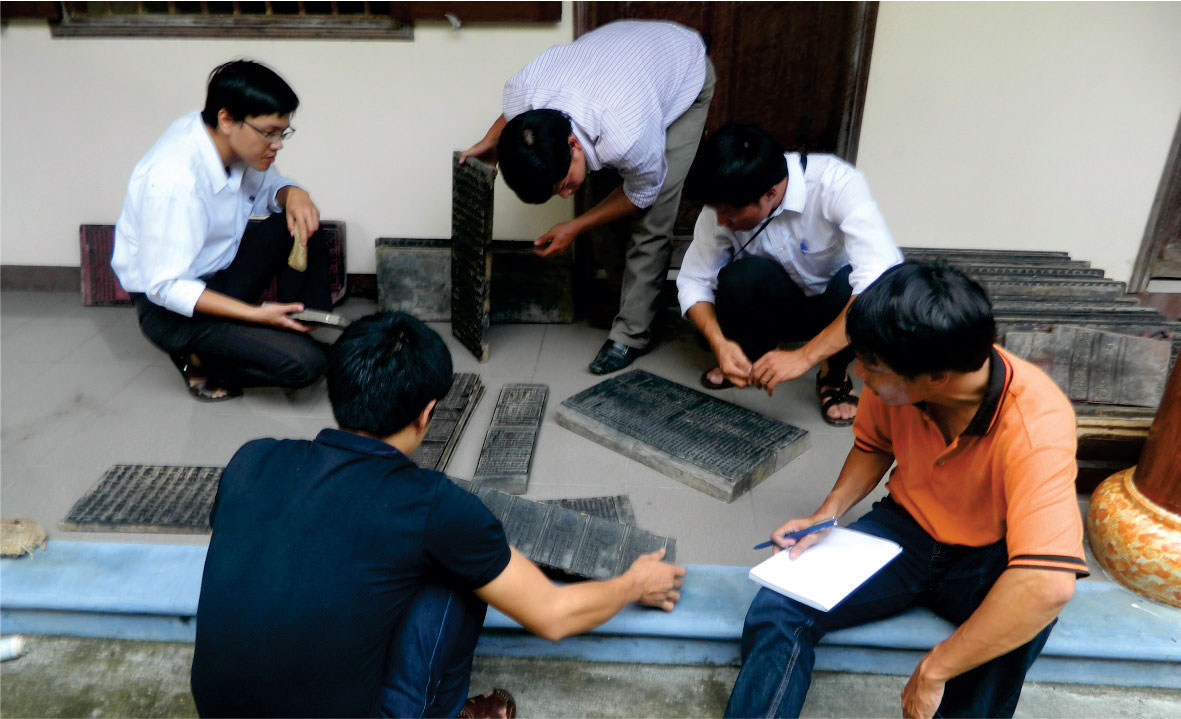
The most notable achievements relate to Hán Nôm documentary heritage. To date, the Center has collected and preserved more than 100 woodblocks and approximately 700 woodblock prints from ancient temples in Hội An such as Vạn Đức, Chúc Thánh, and Phước Lâm; 2,580 pages of documents on Minh Hương commune; 60 original royal decrees and 240 copies of their contents; nearly 4,000 pages of cadastral document copies from villages; 1,600 pages of genealogical records of clans; 2,560 pages of family documents; 370 rubbings of inscriptions; 270 pages of copies of Nguyễn dynasty administrative records related to Hội An; and thousands of photographic files of these materials. To preserve valuable woodblocks at Phước Lâm Pagoda, in 2015 the Center also provided two storage cabinets. Translation and promotion of Hán Nôm documentary heritage have been conducted regularly.
Since 2014, through systematic processing, the Center has selected, translated, compiled, and published nine thematic volumes serving researchers and the public, including: Hội An Hán Nôm Heritage, Volume 1 – Inscriptions (2014); Volume 2 – Archival Materials of the Nguyễn Tường Lineage (2016); Volume 3 – Documents of Minh Hương Commune (2017); Volume 4 – Horizontal Boards and Parallel Sentences (2019); Volume 5 – Family and Clan Archives (2019); Volume 6 – Royal Decrees (2021); and other publications such as Villages in Hội An through Nguyễn Dynasty Cadastral Records and Quảng Nam Gazetteers (2020), Hội An through Nguyễn Dynasty Administrative Records (2021), and 250 Years of the Tây Sơn Movement Viewed from Hội An (2021). These publications help fill historical and cultural gaps while further affirming the outstanding universal values of the World Cultural Heritage site of Hội An Ancient Town.
Through documentary films, museum exhibitions, and thematic displays such as “Nguyễn Dynasty Art in Hội An through Inscription Rubbings and Tomb Steles” and “Marks of Time,” many Hán Nôm documentary heritage items of Hội An have been widely introduced to the public, contributing to the dissemination and promotion of their values.
Following the national seminar on Hội An Ancient Town in 1985, documentary materials in quốc ngữ script, French-language documents, maps, diagrams, and historical photographs have also been actively collected and promoted, helping to reconstruct the cultural and historical landscape of Hội An from the late 19th century onward, particularly its revolutionary history. These materials have played an important role in establishing the exhibition space “Hội An Revolutionary Tradition” and the thematic space “Hội An Rising from Hardship.”
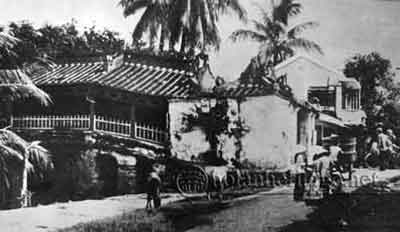
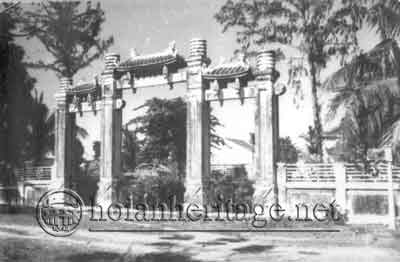
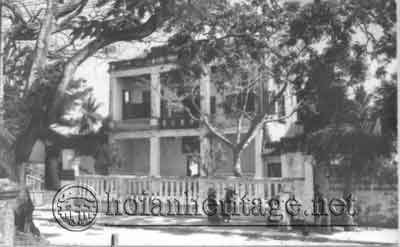
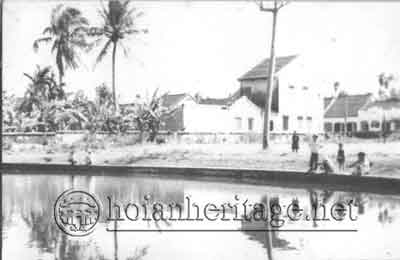
As the provincial capital of Quảng Nam for a long time, photography in Hội An flourished, with a large number of photographers and many well-known studios such as Thiên Chơn Cát, Tiêu Nhiên, Lệ Ảnh, Vĩnh Tân, Huỳnh Sau, Huỳnh Sỏ, Mê Linh, Nhật Quang, Hoàng Nam, Kim Đồng, Vũ Hùng, Hồng Ngọc, etc. As a result, Hội An has preserved a rich collection of historical photographs depicting landscapes, architectural monuments, traditional crafts, cuisine, customs, lifestyles, costumes, and portraits. The Center has collected, digitized, and stored more than 1,000 photographic files of Hội An prior to 1975. This collection is highly valuable in providing vivid and authentic insights into Hội An from the early 20th century to 1975, supporting research, comparison with present-day changes, and restoration of traditional cultural values.
These historical photographs have been displayed and introduced in specialized museums in Hội An, through both physical and online exhibitions such as “Old Hội An” and “Traditional Costumes of Hội An through Photographs,” and have been featured in numerous scholarly publications, especially Hội An: Then and Now.
In the current context, following administrative restructuring and in accordance with the 2024 Law on Cultural Heritage[3] and Circular No. 04/2025/TT-BVHTTDL, the preservation and promotion of Hội An’s documentary heritage require more systematic and in-depth implementation due to the fragile nature of these materials, which are vulnerable to time, environmental conditions, natural disasters, fire, and pests.
In the coming period, the Hội An Center for the Conservation of World Cultural Heritage will continue to coordinate with localities and relevant professional agencies to collect, inventory, catalog, and archive materials, and to prepare dossiers for submission to competent authorities for inclusion in the National Register of Documentary Heritage. At the same time, it will develop plans and projects to enhance preservation and promotion efforts, with particular emphasis on human resource development, investment in preservation equipment systems, the construction of digital databases, and the selection, introduction, and promotion of Hội An’s documentary heritage through publications and multimedia communication.
According to the 2024 Law on Cultural Heritage of Vietnam, documentary heritage is defined as original informational content intentionally created by individuals or groups, directly expressed through symbols, codes, writing, drawings, sound, still or moving images, digital formats, or other forms on original carriers that are accessible and possess historical, cultural, scientific, or aesthetic value for at least one community, and are inherited and transmitted over time. To date, UNESCO has inscribed 570 documentary heritage collections in the Memory of the World Programme, of which Vietnam has 4 World Documentary Heritage items[1] and 7 Asia-Pacific Regional Documentary Heritage items[2].
Woodblock Survey at Phuoc Lam Pagoda (2013) - Photo: Phuoc Tinh
Hội An, with its long-standing and vibrant cultural and historical development, was once one of the most bustling international trading ports in the region for several centuries and also served as the provincial capital of Quảng Nam for an extended period. Therefore, alongside its diverse and distinctive tangible and intangible cultural heritage systems, its documentary heritage is equally rich and remarkable. Survey and statistical results in recent years show that the richness and uniqueness of Hội An’s documentary heritage system lie not only in the diversity of material carriers (paper, wood, stone, metal, etc.), forms of expression (writing, drawing, carving, molding, inlaying, printing, etc.), types of materials (documents, books, newspapers, drawings, diagrams, photographs, films, etc.), and categories (genealogies, land registers, inscriptions, horizontal lacquered boards and parallel sentences, royal decrees, contracts, etc.), but also in the informational value of the content. Within this system, Hán Nôm documentary heritage is considered the most abundant and diverse component, providing significant information that helps clarify the historical and cultural values of monuments and sites, the lives and careers of individuals, as well as the history and cultural traditions of communities and of Hội An as an international trading port.
Recognizing the importance and significance of Hội An’s documentary heritage system, over the past decades, the work of collecting, researching, preserving, and promoting this heritage has been given special attention by the Hội An Center for the Conservation of World Cultural Heritage, achieving numerous results and establishing a repository of tens of thousands of pages of raw and digitized materials.
The most notable achievements relate to Hán Nôm documentary heritage. To date, the Center has collected and preserved more than 100 woodblocks and approximately 700 woodblock prints from ancient temples in Hội An such as Vạn Đức, Chúc Thánh, and Phước Lâm; 2,580 pages of documents on Minh Hương commune; 60 original royal decrees and 240 copies of their contents; nearly 4,000 pages of cadastral document copies from villages; 1,600 pages of genealogical records of clans; 2,560 pages of family documents; 370 rubbings of inscriptions; 270 pages of copies of Nguyễn dynasty administrative records related to Hội An; and thousands of photographic files of these materials. To preserve valuable woodblocks at Phước Lâm Pagoda, in 2015 the Center also provided two storage cabinets. Translation and promotion of Hán Nôm documentary heritage have been conducted regularly.
Since 2014, through systematic processing, the Center has selected, translated, compiled, and published nine thematic volumes serving researchers and the public, including: Hội An Hán Nôm Heritage, Volume 1 – Inscriptions (2014); Volume 2 – Archival Materials of the Nguyễn Tường Lineage (2016); Volume 3 – Documents of Minh Hương Commune (2017); Volume 4 – Horizontal Boards and Parallel Sentences (2019); Volume 5 – Family and Clan Archives (2019); Volume 6 – Royal Decrees (2021); and other publications such as Villages in Hội An through Nguyễn Dynasty Cadastral Records and Quảng Nam Gazetteers (2020), Hội An through Nguyễn Dynasty Administrative Records (2021), and 250 Years of the Tây Sơn Movement Viewed from Hội An (2021). These publications help fill historical and cultural gaps while further affirming the outstanding universal values of the World Cultural Heritage site of Hội An Ancient Town.
Through documentary films, museum exhibitions, and thematic displays such as “Nguyễn Dynasty Art in Hội An through Inscription Rubbings and Tomb Steles” and “Marks of Time,” many Hán Nôm documentary heritage items of Hội An have been widely introduced to the public, contributing to the dissemination and promotion of their values.
Following the national seminar on Hội An Ancient Town in 1985, documentary materials in quốc ngữ script, French-language documents, maps, diagrams, and historical photographs have also been actively collected and promoted, helping to reconstruct the cultural and historical landscape of Hội An from the late 19th century onward, particularly its revolutionary history. These materials have played an important role in establishing the exhibition space “Hội An Revolutionary Tradition” and the thematic space “Hội An Rising from Hardship.”
As the provincial capital of Quảng Nam for a long time, photography in Hội An flourished, with a large number of photographers and many well-known studios such as Thiên Chơn Cát, Tiêu Nhiên, Lệ Ảnh, Vĩnh Tân, Huỳnh Sau, Huỳnh Sỏ, Mê Linh, Nhật Quang, Hoàng Nam, Kim Đồng, Vũ Hùng, Hồng Ngọc, etc. As a result, Hội An has preserved a rich collection of historical photographs depicting landscapes, architectural monuments, traditional crafts, cuisine, customs, lifestyles, costumes, and portraits. The Center has collected, digitized, and stored more than 1,000 photographic files of Hội An prior to 1975. This collection is highly valuable in providing vivid and authentic insights into Hội An from the early 20th century to 1975, supporting research, comparison with present-day changes, and restoration of traditional cultural values.
These historical photographs have been displayed and introduced in specialized museums in Hội An, through both physical and online exhibitions such as “Old Hội An” and “Traditional Costumes of Hội An through Photographs,” and have been featured in numerous scholarly publications, especially Hội An: Then and Now.
In the current context, following administrative restructuring and in accordance with the 2024 Law on Cultural Heritage[3] and Circular No. 04/2025/TT-BVHTTDL, the preservation and promotion of Hội An’s documentary heritage require more systematic and in-depth implementation due to the fragile nature of these materials, which are vulnerable to time, environmental conditions, natural disasters, fire, and pests.
In the coming period, the Hội An Center for the Conservation of World Cultural Heritage will continue to coordinate with localities and relevant professional agencies to collect, inventory, catalog, and archive materials, and to prepare dossiers for submission to competent authorities for inclusion in the National Register of Documentary Heritage. At the same time, it will develop plans and projects to enhance preservation and promotion efforts, with particular emphasis on human resource development, investment in preservation equipment systems, the construction of digital databases, and the selection, introduction, and promotion of Hội An’s documentary heritage through publications and multimedia communication.
[1] Nguyễn Dynasty Woodblocks (2009); 82 Stone Steles of the Lê–Mạc Dynasty Doctoral Examinations (2011); Nguyễn Dynasty Administrative Records (Châu bản) (2017); The Collection of Musician Hoàng Vân (2025).
[2] Buddhist Woodblocks of Vĩnh Nghiêm Pagoda (2012); System of Literary and Poetic Inscriptions on Huế Imperial Architecture (2016); Phúc Giang School Woodblocks (2016); Hoàng Hoa Envoy Route Map (2018); Ma Nhai Inscriptions at the Ngũ Hành Sơn Scenic Landscape, Đà Nẵng (2022); Hán Nôm Documents of Trường Lưu Village, Hà Tĩnh (2022); Relief Castings on the Nine Dynastic Urns in the Huế Imperial Citadel (2024).
[3] In the 2024 Law on Cultural Heritage, documentary heritage is, for the first time, codified into a separate chapter consisting of 11 articles (Articles 53 to 63). These provisions specifically regulate the protection and promotion of documentary heritage values, including: classification and criteria for identifying documentary heritage; inventory and inventory lists; criteria and procedures for inscription and additional inscription; inscription, additional inscription, and removal from inscription; preservation; research and collection; restoration; management, protection, and value promotion activities; development of programs, projects, plans, and periodic reporting after inscription; the movement of inscribed documentary heritage for exhibition, research, or preservation domestically and internationally; repatriation of Vietnamese-origin documentary heritage from abroad; and reproduction of documentary heritage.
Author: Võ Hồng Việt
Source: Hoi An Center for the Conservation of World Cultural Heritage
Newer articles
Older articles