Hoi An World Cultural Heritage Conservation Center
Events related to Hội An in Horse years through historical records
With its historical and cultural-geographical position, Hội An emerged early as a center of trade and exchange with countries in the region and beyond. During the Lâm Ấp – Champa period, Hội An was already a trading port frequented by foreign merchant ships. Several historical works recorded valuable information about Hội An, including the Jin Shu (History of the Jin), Tang Shu (History of the Tang), and a number of early Arabic texts.
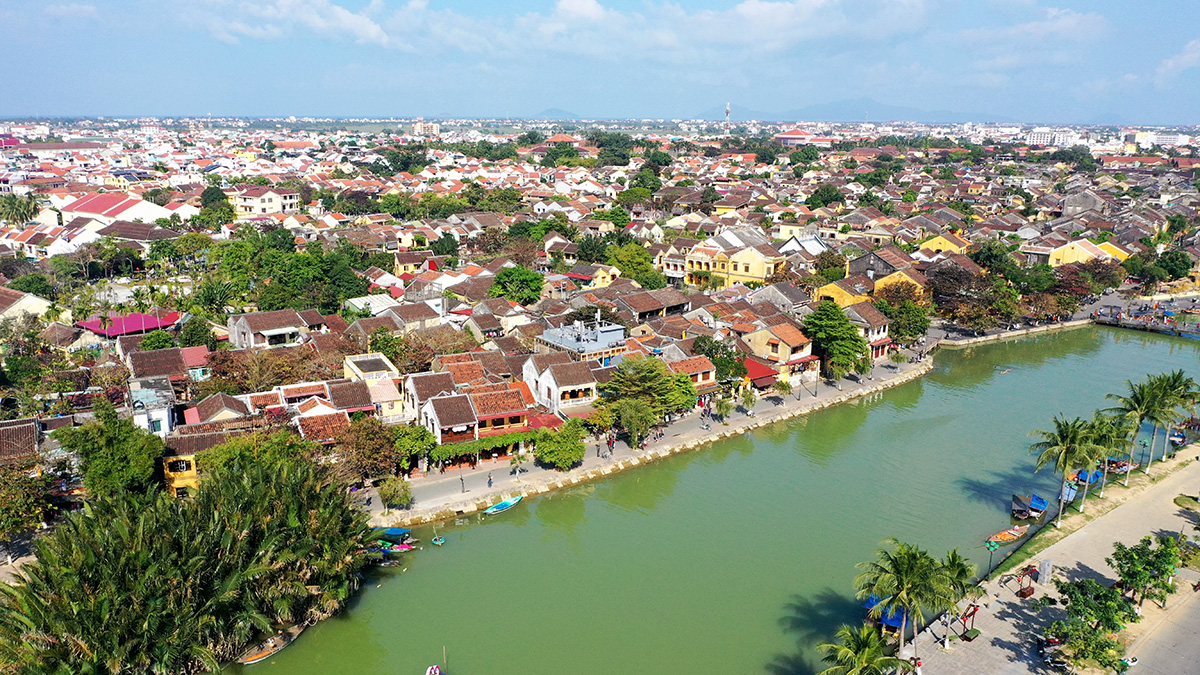
Aerial view of Hoi An Ancient Town – Photo: Quang Ngoc
Later, when Hội An reached its peak as an international trading port under the Nguyễn lords, followed by the Tây Sơn period and the Nguyễn dynasty, numerous works mentioning or relating to Hội An were published, such as Đại Nam thực lục (Veritable Records of Đại Nam), Đại Nam nhất thống chí (Unified Gazetteer of Đại Nam), A Voyage to Cochinchina, Travels and Missions, The Land of Cochinchina in 1621, and Hải ngoại kỷ sự (Overseas Chronicles). In addition, Hán Nôm materials such as imperial administrative documents (châu bản), genealogical records, and cadastral registers contain extensive information about Hội An. Together, these sources form a unique body of historical documentation, offering valuable insights into Hội An from the 16th to 18th centuries.Below are selected events and information related to Hội An in Horse years (Ngọ), as recorded in both domestic and foreign sources.
Mậu Ngọ (1618)
The missionary Cristophoro Borri arrived in Cochinchina (Đàng Trong), including Hội An, with the mission of evangelization, becoming one of the earliest missionaries in the region. During his stay, he recorded observations about Hội An in The Land of Cochinchina in 1621:
On the port: “...The most beautiful port, where all foreigners gather and where the most renowned market is held, is the port in Quảng Nam province. Ships enter through two sea gates: one called Turon (Đà Nẵng) and the other Pulluciambello (Hội An). These two entrances are about three or four miles apart. From there, the sea divides into two branches that extend inland for seven or eight miles, forming two rivers that eventually join into one large river. Ships from both directions enter this same river[1].”
On trade: “The Lord of Cochinchina formerly allowed the Japanese and Chinese to select a convenient place to establish a town for trade, as we have said. This town is called Faifo (Hội An), so large that it may be considered two cities: one Chinese quarter and one Japanese quarter. Each has its own district, its own officials, and lives according to its own customs. The Chinese follow Chinese laws and customs, and the Japanese likewise[2].”
On products, especially bird’s nests: “In this land there is a small bird resembling a swallow… The inhabitants collect their nests, soak them in water until softened and dissolved, and use them as a delicacy… It is a very fine dish, reserved exclusively for the Lord, who sends large quantities as tribute to the Chinese emperor, who greatly favors it[3].”
Giáp Ngọ (1774)
In Giáp Ngọ niên bình nam đồ, in the section depicting Quảng Nam, Bùi Thế Đạt recorded place names such as Hội An phố (Hội An town), Hội An Đàm, the Đại Chiêm estuary, and Tiêm Bút mountain (Cù Lao Chàm). Earlier, these locations had also been noted in Thiên Nam tứ chí lộ đồ by Đỗ Bá.
Canh Ngọ (1810)
A Siamese merchant ship was blown off course by strong winds and drifted into the Đại Chiêm estuary. The king ordered local officials in Quảng Nam to provide provisions for over 400 people aboard for ten days, then allowed them to return home.
In the same year, authorities in Thanh Hà and Hội An were tasked with investigating Qing (Chinese) merchants. Regulations stipulated that Qing merchants typically stayed for three to four months before returning home. Those wishing to remain longer or travel elsewhere for trade required local guarantees and official permits. Unauthorized stays or movement would result in punishment[4].
Nhâm Ngọ (1822)
In the 3rd year of Emperor Minh Mạng (1822), Diên Khánh district was renamed Diên Phước district[5]. At this time, Hội An belonged to Diên Phước district, Điện Bàn prefecture.That same year, a British delegation led by John Crawfurd arrived in Hội An. During their stay (22–24 October 1822), Crawfurd noted: “Hội An is the principal trading center of the northern provinces of Cochinchina, about 36 miles south of Đà Nẵng Bay. The merchants here are all Chinese, and they eagerly seek opportunities to establish trade relations with England[6].”
On trading vessels: “From Hainan: 3 junks, each with a capacity of 2,750 đảm[7]; from Guangzhou: 6 junks, each 3,000 đảm; from Fujian: 4 junks, each 3,000 tons; from Jiangnan and Zhejiang: 2 junks, each 2,500 đảm[8].”
Also in this year, the Ministry of Revenue issued regulations to Hồ Văn Hòa, head of the bird’s nest harvesting guild (yến hộ) in Thanh Châu village, regarding the organization of fleets: 40 members: 12 boats; 36+ members: 8 boats; 20+ members: 5 boats; 10+ members: 2 boats.
Boat width ranged from approximately 2.0 meters to 2.76 meters. These vessels were officially registered as “yến hộ boats” and taxed accordingly[9].
Bính Ngọ (1846)
The official in charge of Đại Chiêm estuary, Nguyễn Dưỡng, reported that six Qing subjects had drifted into the coastal area of Phước Trạch village. They were from Đồng An district, Tuyền Châu prefecture, Fujian province. Their vessel, commanded by Trần Cấp with 15 crew members, had departed on the 16th day of the 8th lunar month for Taiwan. On the 19th, it encountered strong northern winds, causing severe damage: the hull broke, the rudder and mast collapsed. Nine people, including the captain, went missing.
The remaining six drifted ashore and requested temporary residence in Hội An while waiting for a Chinese ship to return home. Local authorities, recognizing their misfortune, allowed them to stay, provided each with rice and basic necessities, and entrusted their supervision to the Chinese community leader until passage could be arranged[10].
Canh Ngọ (1910)
The Governor-General of Nam Ngãi, Hồ Đắc Trung, requested an increase in personnel for the Nam Cẩm relay station in Cẩm Phô village, which was approved. Accordingly, five laborers were reassigned from Miếu Bông station (originally 16 workers) to Nam Cẩm. These workers received official wages and were exempted from annual corvée taxes.
In the same year, according to a petition by Venerable Vĩnh Gia, Phước Lâm Pagoda in Thanh Hà village, Diên Phước district, Quảng Nam province, was an ancient temple founded over 100 years earlier. Despite multiple restorations, it retained its traditional character, and its monks strictly observed Buddhist precepts. A petition was submitted requesting imperial recognition.
The Ministry of Rites reviewed the request and presented it to the court, which approved it[11]. The imperial inscribed plaque granted by the court is still prominently displayed in the main hall of Phước Lâm Pagoda today.
[1] Cristophoro Borri (1998), Cochinchina in 1621, translated by Hồng Nhuệ, Nguyễn Khắc Xuyên, Nguyễn Nghị, Ho Chi Minh City Publishing House, pp. 91.
[2] Christophoro Borri (1998), op. cit., p. 92.
[3] Christophoro Borri (1998), op. cit., p. 30-31.
[4] Quốc sử quán triều Nguyễn (trans.) (2007), Đại Nam thực lục (The Veritable Records of Đại Nam), vol. 1, Education Publishing House, Hanoi, pp. 783–784.
[5] Quốc sử quán triều Nguyễn (trans.) (2007), Đại Nam thực lục (The Veritable Records of Đại Nam), vol. 2, Education Publishing House, Hanoi, pp. 249.
[6] Alastair Lamb (trans., 2022), The Mandarin Road: The Strange Journey of British Missions to Vietnam in the 17th–19th Centuries, translated by Đinh Tuấn Nghĩa, edited by Nguyễn Thị Thúy Thúy, Nguyễn Văn Hưởng Library, Writers’ Association Publishing House, p. 378.
[7] One đảm equals 100 catties or 133⅓ pounds (avoirdupois).
[8] Alastair Lamb (trans., 2022), op. cit., p. 401.
[9] Archival materials on the bird’s nest harvesting profession in Thanh Châu: Official document from Nguyễn Hữu Thận (Ministry of Revenue) to Hồ Văn Hòa, copy preserved at the Hội An Center for Cultural Heritage Management and Preservation.
[10] Nguyễn Dynasty imperial records (châu bản): Memorial from the Ministry of Revenue regarding Qing subjects requesting temporary residence in Hội An and approval of support provisions, copy preserved at the Hội An Center for Cultural Heritage Management and Preservation.
[11] Nguyễn Dynasty imperial records (châu bản): Memorial concerning the proposal to confer an imperial title on Phước Lâm Pagoda, copy preserved at the Hội An Center for Cultural Heritage Management and Preservation.
Author: Phạm Phước Tịnh
Source: Hoi An Center for the Conservation of World Cultural Heritage
Newer articles
Older articles