Hoi An World Cultural Heritage Conservation Center
Three-Bay House with a Projecting Front Room – A House of Memory and Nostalgia
A house is not merely a structure that shelters people from sun and rain; it is a symbol of home, a place of kinship, safety, and belonging. It preserves memories and connects family members, carrying profound spiritual value.
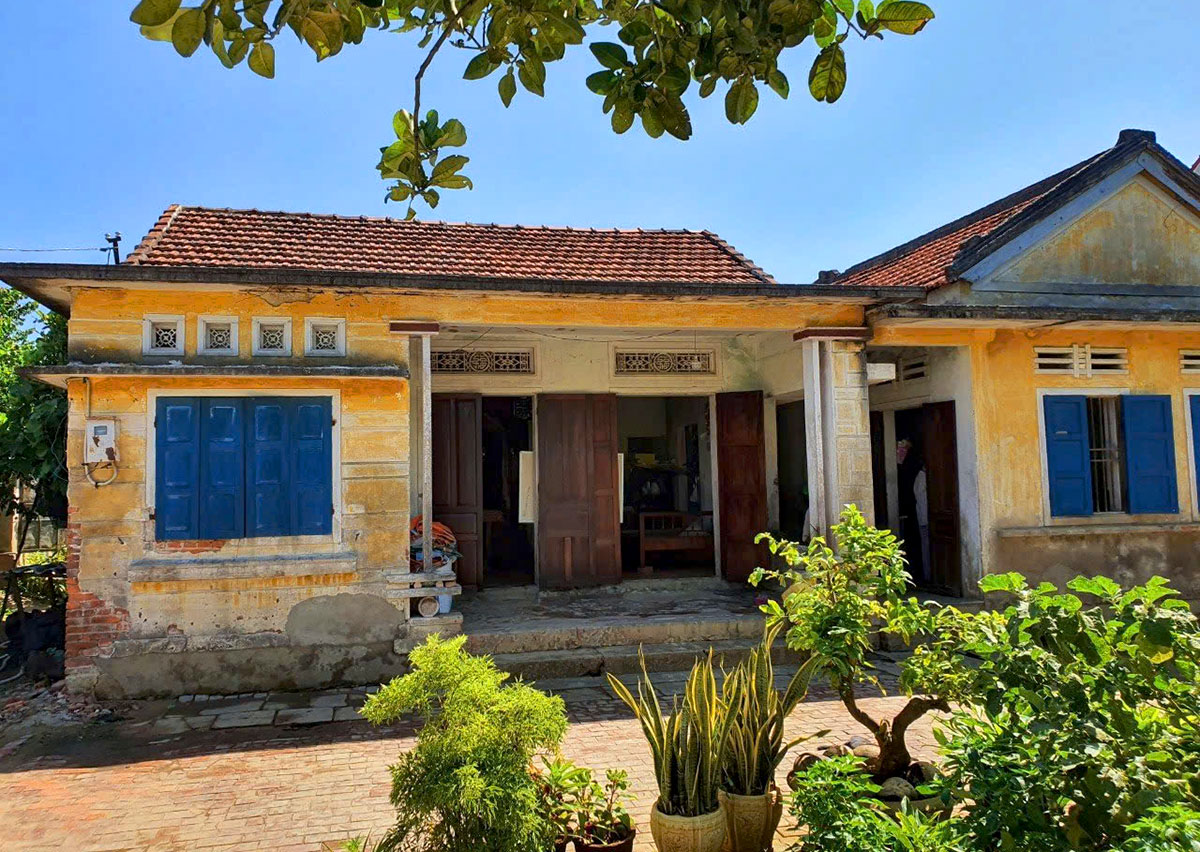
A three-bay house with a projecting front room in Hoi An Dong ward - Photo: Dinh Hieu
For this reason, the image of a house is often associated with a wide range of emotional memories. Depending on region and locality, houses take on different forms, shaped by natural conditions, living practices, and the financial capacity of their owners, thereby creating distinct architectural identities.
Many people born in the 1980s and 1990s, and even some from the 1970s in peri-urban and rural areas of Central and Southern Vietnam, have either seen or grown up in a common house type that can be informally described, based on its façade composition, as a “house with a projecting room” (phòng lồi). Although not officially classified as part of traditional Vietnamese housing typologies, this form evokes strong nostalgia, as many of these houses are now nearly half a century old.
“Projecting room” is a vernacular term referring to a space that extends outward from the main front wall of the house. In a typical three-bay traditional house, the façade aligns along a straight plane. In this variation, however, one side bay is pushed forward, forming an L-shaped frontage. There is no definitive documentation on when this type first appeared, but it likely emerged around the 1970s. It became widespread and particularly popular during the 1980s and 1990s. Architecturally, it represents a hybrid form that combines modern elements with traditional spatial organization. The three-bay structure is retained, suggesting that this type is an evolutionary development of the traditional three-bay house. It reflects a creative adaptation that expands usable space while preserving the fundamental symmetry of the original layout. While modern urban architecture often experiments with new geometric forms and minimalist façades, rural housing has tended to integrate modern features with traditional spatial organization, particularly in layout and massing. Even as new materials and styles were introduced as people enthusiastically showcased minimalist façades finished with exposed aggregate and articulated into geometric panels, the familiar bay-and-wing structure remained, reflecting continuity in everyday living patterns. Many newly built houses retained traditional arrangements, especially the “đinh-shaped” (T-shaped) layout[1].
Houses with projecting rooms are typically single-storey structures set within spacious plots, extending horizontally and surrounded by open gardens. From the front, the three-bay structure is easily recognizable. The projecting room occupies one bay, while the other two bays feature deep verandas that effectively shield against sun and rain. The bay dimensions are not equal: the central bay is usually the smallest, while the projecting bay is larger than the remaining side bay, differing from the traditional three-bay house where the two side bays are symmetrical[2].
This house type features visually distinctive forms that were considered modern at the time of construction, yet it retains core elements of traditional architecture. Modern influences are evident in features such as reinforced concrete gutters running along the façade; cement-rendered walls and columns divided by horizontal and vertical scoring lines in a minimalist style; lime-washed surfaces with white joint lines; and in some cases, exposed aggregate finishes. Ventilation blocks made of precast cement, or simple reinforced concrete lintels above doors and windows, are also common. The front openings typically include wide windows in the projecting bay and entrance doors in the other bays, often made of wooden panels with glass inserts or louvered shutters, usually painted in blue or green, standing out against traditional yellow or off-white walls.
Inside, the house retains familiar traditional structural elements, including two pairs of simple rafters with rectangular sections and minimal ornamentation. The structural system typically follows the “con tiền cái hậu” arrangement, where the front column row may be omitted or simplified. In some houses, a secondary front pillar is present; in others, the framework main beams rest directly on the front wall or masonry piers. Some structures use beams without columns. Floors are finished with cement screed, brick tiles, or, in more affluent households, patterned cement tiles. Roofs are covered with fired clay tiles (arrow-shaped tiles) or cement tiles.
The functional layout closely follows that of the traditional three-bay house: the central bay serves as the main space for ancestor worship and receiving guests, while the two side bays are used for sleeping or storage. The addition is the projecting room at the front. The ancestral altar is placed in the central bay, with a wooden reception set in front. Brick partition walls on either side create a more solemn space. The side bays may include storage or bedrooms, with windows ensuring ventilation. The projecting room is often used as a bedroom, study, or workspace, with windows on both the front and side walls, providing ventilation, natural light, and views, while also allowing observation of the surroundings and connection to the outdoors.
Typically, this house type does not have an extended rear wing as in urban tube houses; instead, it includes a separate auxiliary building located to one side, aligned with or slightly projecting beyond the main façade. This auxiliary structure contains additional bedrooms, kitchen, and sometimes sanitary facilities.
As architectural trends evolve, both rural and urban housing are influenced by changing conditions. Urban “tube houses” suit dense city environments but are less compatible with rural landscapes and lifestyles. Conversely, the three-bay house with a projecting room can be adapted to urban settings, offering a more balanced and visually harmonious façade. In urban contexts, however, these houses differ from their rural counterparts by lacking separate auxiliary structures; instead, additional rooms are arranged in sequence behind the main house, connected by corridors.
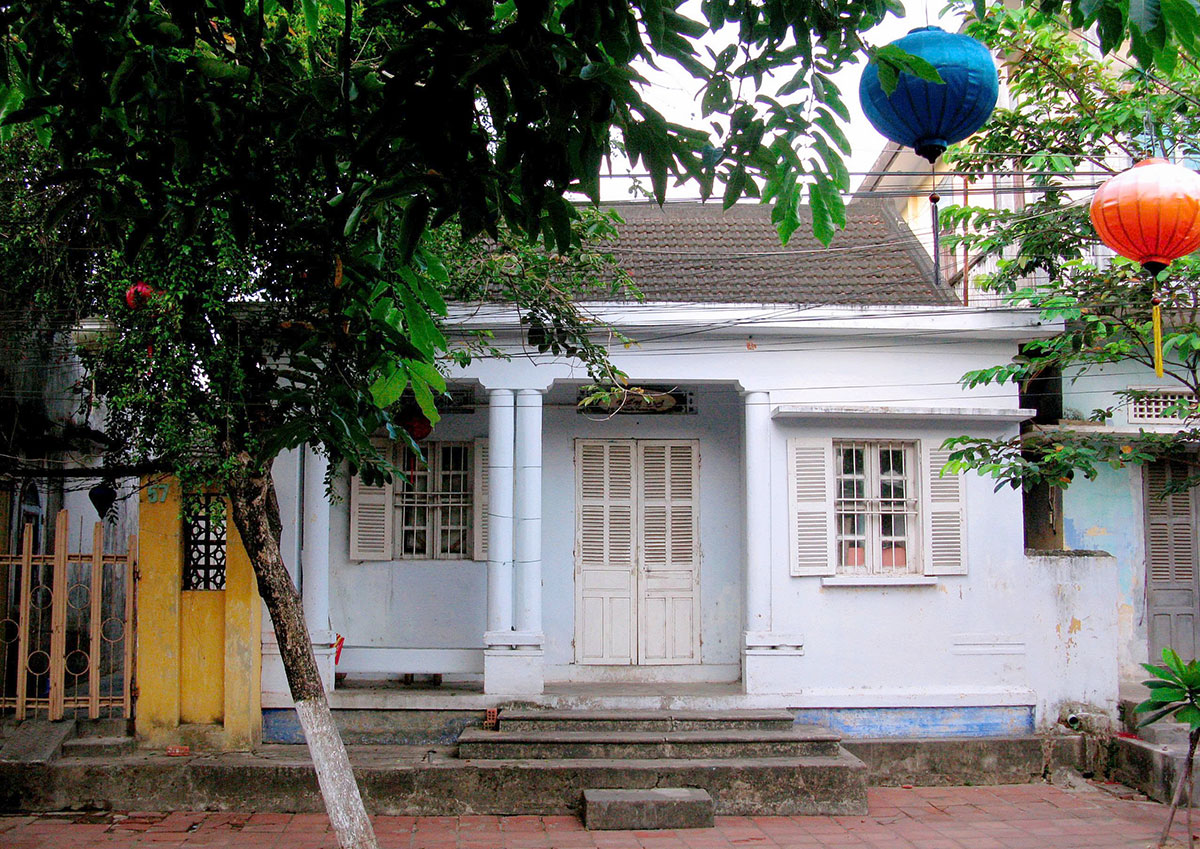
Within the Hội An Ancient Town, several houses of this type still exist, such as those at 37, 47, and 38 Nguyễn Thị Minh Khai Street[3]. In surrounding areas, including Hội An Đông, Hội An Tây, and Tân Hiệp island commune, similar houses can still be found. These are not merely dwellings but enduring evidence of the vitality of traditional architecture. Amid the growing popularity of modern villas and contemporary styles, the three-bay house with a projecting room continues to evoke a sense of calm, familiarity, and nostalgia.
Over time, rural houses once considered modern have themselves become “old houses,” associated with previous generations. What was once modern gradually becomes part of tradition. A structure that was new a few decades ago becomes a repository of family memory and part of the continuous flow of architectural heritage[4]. The house with a projecting room stands as a clear example of the evolution of vernacular architecture, marking a particular phase in the history of domestic space while embodying distinct architectural values.
Today, however, these houses are rapidly disappearing under the pressures of urbanization, replaced by more contemporary forms. Preserving them would help retain an important and evocative layer of architectural memory within the broader heritage landscape of Hội An Ancient Town.
Many people born in the 1980s and 1990s, and even some from the 1970s in peri-urban and rural areas of Central and Southern Vietnam, have either seen or grown up in a common house type that can be informally described, based on its façade composition, as a “house with a projecting room” (phòng lồi). Although not officially classified as part of traditional Vietnamese housing typologies, this form evokes strong nostalgia, as many of these houses are now nearly half a century old.
“Projecting room” is a vernacular term referring to a space that extends outward from the main front wall of the house. In a typical three-bay traditional house, the façade aligns along a straight plane. In this variation, however, one side bay is pushed forward, forming an L-shaped frontage. There is no definitive documentation on when this type first appeared, but it likely emerged around the 1970s. It became widespread and particularly popular during the 1980s and 1990s. Architecturally, it represents a hybrid form that combines modern elements with traditional spatial organization. The three-bay structure is retained, suggesting that this type is an evolutionary development of the traditional three-bay house. It reflects a creative adaptation that expands usable space while preserving the fundamental symmetry of the original layout. While modern urban architecture often experiments with new geometric forms and minimalist façades, rural housing has tended to integrate modern features with traditional spatial organization, particularly in layout and massing. Even as new materials and styles were introduced as people enthusiastically showcased minimalist façades finished with exposed aggregate and articulated into geometric panels, the familiar bay-and-wing structure remained, reflecting continuity in everyday living patterns. Many newly built houses retained traditional arrangements, especially the “đinh-shaped” (T-shaped) layout[1].
Houses with projecting rooms are typically single-storey structures set within spacious plots, extending horizontally and surrounded by open gardens. From the front, the three-bay structure is easily recognizable. The projecting room occupies one bay, while the other two bays feature deep verandas that effectively shield against sun and rain. The bay dimensions are not equal: the central bay is usually the smallest, while the projecting bay is larger than the remaining side bay, differing from the traditional three-bay house where the two side bays are symmetrical[2].
This house type features visually distinctive forms that were considered modern at the time of construction, yet it retains core elements of traditional architecture. Modern influences are evident in features such as reinforced concrete gutters running along the façade; cement-rendered walls and columns divided by horizontal and vertical scoring lines in a minimalist style; lime-washed surfaces with white joint lines; and in some cases, exposed aggregate finishes. Ventilation blocks made of precast cement, or simple reinforced concrete lintels above doors and windows, are also common. The front openings typically include wide windows in the projecting bay and entrance doors in the other bays, often made of wooden panels with glass inserts or louvered shutters, usually painted in blue or green, standing out against traditional yellow or off-white walls.
Three-bay house with a projecting front room on Nguyen Thi Minh Khai street, Hoi An ward - Photo: Hoang Phuc
Some houses have reinforced concrete flooring in the veranda and projecting room, while others extend the roof over this area, albeit at a lower pitch than the main roof, creating a visible break in the roofline when viewed from the side. A notable feature is the inscription of the construction date on the façade beam beneath the gutter, commonly dating from the period after 1985 to around 1990. This detail likely serves as a commemorative marker of the house’s construction.Inside, the house retains familiar traditional structural elements, including two pairs of simple rafters with rectangular sections and minimal ornamentation. The structural system typically follows the “con tiền cái hậu” arrangement, where the front column row may be omitted or simplified. In some houses, a secondary front pillar is present; in others, the framework main beams rest directly on the front wall or masonry piers. Some structures use beams without columns. Floors are finished with cement screed, brick tiles, or, in more affluent households, patterned cement tiles. Roofs are covered with fired clay tiles (arrow-shaped tiles) or cement tiles.
The functional layout closely follows that of the traditional three-bay house: the central bay serves as the main space for ancestor worship and receiving guests, while the two side bays are used for sleeping or storage. The addition is the projecting room at the front. The ancestral altar is placed in the central bay, with a wooden reception set in front. Brick partition walls on either side create a more solemn space. The side bays may include storage or bedrooms, with windows ensuring ventilation. The projecting room is often used as a bedroom, study, or workspace, with windows on both the front and side walls, providing ventilation, natural light, and views, while also allowing observation of the surroundings and connection to the outdoors.
Typically, this house type does not have an extended rear wing as in urban tube houses; instead, it includes a separate auxiliary building located to one side, aligned with or slightly projecting beyond the main façade. This auxiliary structure contains additional bedrooms, kitchen, and sometimes sanitary facilities.
As architectural trends evolve, both rural and urban housing are influenced by changing conditions. Urban “tube houses” suit dense city environments but are less compatible with rural landscapes and lifestyles. Conversely, the three-bay house with a projecting room can be adapted to urban settings, offering a more balanced and visually harmonious façade. In urban contexts, however, these houses differ from their rural counterparts by lacking separate auxiliary structures; instead, additional rooms are arranged in sequence behind the main house, connected by corridors.
Within the Hội An Ancient Town, several houses of this type still exist, such as those at 37, 47, and 38 Nguyễn Thị Minh Khai Street[3]. In surrounding areas, including Hội An Đông, Hội An Tây, and Tân Hiệp island commune, similar houses can still be found. These are not merely dwellings but enduring evidence of the vitality of traditional architecture. Amid the growing popularity of modern villas and contemporary styles, the three-bay house with a projecting room continues to evoke a sense of calm, familiarity, and nostalgia.
Over time, rural houses once considered modern have themselves become “old houses,” associated with previous generations. What was once modern gradually becomes part of tradition. A structure that was new a few decades ago becomes a repository of family memory and part of the continuous flow of architectural heritage[4]. The house with a projecting room stands as a clear example of the evolution of vernacular architecture, marking a particular phase in the history of domestic space while embodying distinct architectural values.
Today, however, these houses are rapidly disappearing under the pressures of urbanization, replaced by more contemporary forms. Preserving them would help retain an important and evocative layer of architectural memory within the broader heritage landscape of Hội An Ancient Town.
[1] Tản mạn kiến trúc authors’ group (2022), Tản mạn kiến trúc Nam Bộ, Thế Giới Publishing House, pp. 68–69.
[2] In a traditional three-bay, two-wing house, the central bay is typically the widest compared to the side bays and wings. In a standard three-bay house, the central bay is usually equal in width to, or slightly smaller than, the two side bays. By contrast, in houses with a projecting front room, the central bay is the smallest, while the projecting bay is wider than the remaining side bay.
[3]Among these, House No. 38 has had the window in the projecting room modified into a doorway.
[4] Tản mạn kiến trúc authors’ group (2022), Tản mạn kiến trúc Nam Bộ, Thế Giới Publishing House, pp. 70.
Author: Trần Thanh Hoàng Phúc
Source: Hoi An Center for the Conservation of World Cultural Heritage
Newer articles
Older articles