Hoi An World Cultural Heritage Conservation Center
Guidelines for “Erecting the New Year Pole (Cây Nêu)” – Lunar New Year Bính Ngọ 2026
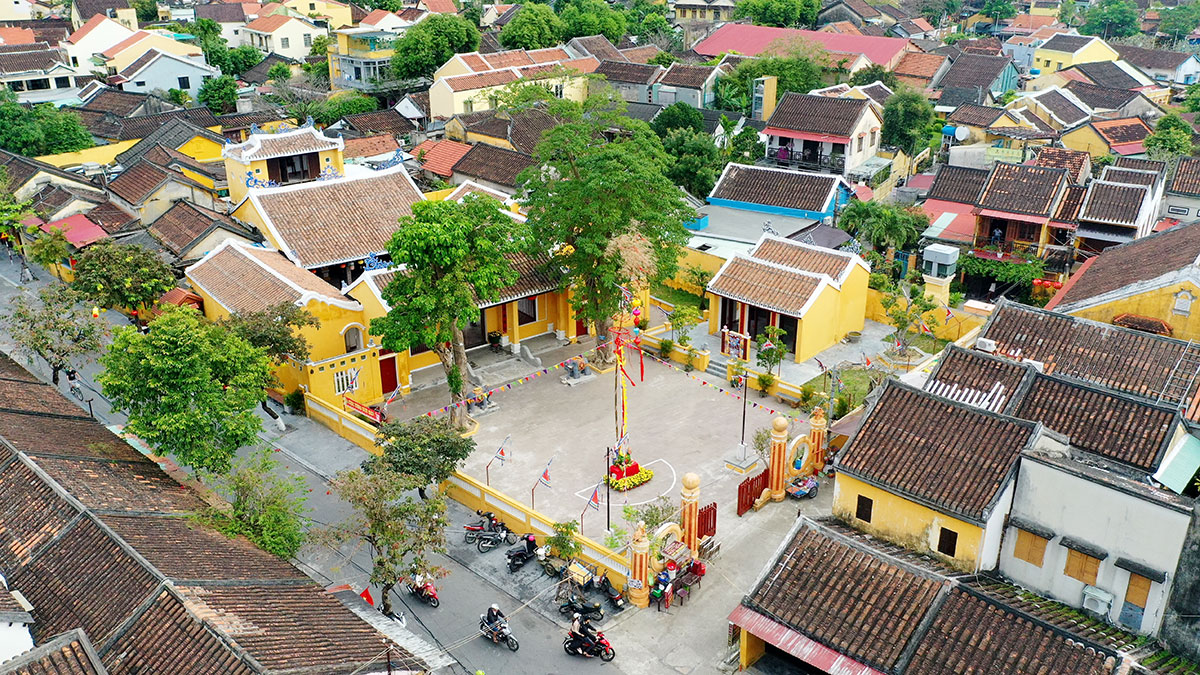
The Nêu pole symbolizes the expulsion of evil spirits, the warding off of malevolent forces, the wish for peace, favorable weather, and also affirms the territorial ownership of households, villages, and communities.
For this reason, the Nêu pole holds an important place in the spiritual life of Vietnamese people and serves as a vivid image that enhances the lively, festive, and colorful atmosphere of the early days of the new year. Maintaining the practice of erecting the Nêu pole contributes to preserving and safeguarding the distinctive traditional cultural heritage of the locality and the nation.
According to historical sources, in the southern region (Đàng Trong) as well as in Hội An, people traditionally erected the Nêu pole in the final days of the year. In Gia Định thành thông chí, published during the Minh Mạng reign in the early 19th century, Trịnh Hoài Đức recorded:
“On New Year’s Eve, in front of the main gate of every household, a bamboo pole is erected. At its top is hung a small bamboo basket containing betel leaves, areca nuts, and lime, with gold and silver papers attached. This is called erecting the Nêu pole. On the seventh day of Tết, it is taken down, which is called lowering the Nêu pole. During the Tết days, debts are not to be demanded; only after the Nêu pole is lowered may they be collected.”
In Đại Nam thực lục chính biên, volume six, under the year Ất Tỵ (1845) during the reign of Thiệu Trị, it is recorded that the Nêu pole is erected on the last day of the lunar year: the 30th day for a full month or the 29th day for a short month.
From these records, the erection date generally falls on the final day of the year. However, in Hội An, folk sources indicate that some villages erect the Nêu pole earlier, from the 23rd day of the twelfth lunar month onward.
In implementing the plan to organize the “New Year Pole Competition” for Spring Bính Ngọ 2026, aimed at restoring and honoring traditional cultural values of Hội An Ancient Town and creating a vibrant festive atmosphere, the Hội An Center for Cultural Heritage Management and Preservation provides the following guidelines:
Materials
Pole: A mature bamboo tree, tall, straight, sturdy, with fresh leaves at the top.
Guy ropes: At least three strong ropes.
Stakes: Bamboo stakes firmly fixed to secure the ropes at the base.
Form and Decoration
Flag: A large square festival flag (Five Elements flag), with a red or yellow center and no black or dark purple borders, hung below the bamboo leaves. The flagpole is attached diagonally to the bamboo and secured firmly.
Streamer (phướn): Traditionally made of paper with the names of deities assigned for the year (such as Hành Khiển, Hành Binh, Thái Tuế). Today it may be replaced with red cloth bearing auspicious phrases such as “Wishing the nation peace and prosperity, favorable weather” or “Happy New Year,” “Prosperity and well-being.” Traditional wording is encouraged. The streamer hangs below the flag.
Sound-making objects: Traditionally clay bells or ceramic chimes; now wind chimes may be used. These are hung beneath the bamboo leaves using a circular bamboo ring.
Ritual objects (local tradition): A branch of banyan, pandan leaves, or cactus; or a small bamboo basket containing votive paper, rice, salt, betel, and areca; along with a square bamboo lattice (4 vertical and 5 horizontal strips) symbolizing “four directions and five elements.” These are hung below the leaves.
Lanterns: Decorated around the pole area and at the top of the pole, preferably in traditional colors such as red and yellow.
Guy rope decorations: Spring couplets, small diagonal flags, or other appropriate ornaments.
Base decoration: Spring couplets, symbolic Tết foods (cakes, fruits), etc.To enhance the surrounding space, additional decorations may include lanterns, ornamental plants, panels, or symbolic models such as bánh chưng, bánh tét, zodiac animals, or auspicious motifs (Phúc, Lộc, Thọ). Large Five Elements flags may also be used, avoiding black, dark purple, or white.Note: Avoid using flashing electric lights or modern synthetic materials. Environmentally friendly materials are encouraged.
Rituals for Erecting and Lowering the Pole
Erecting ritual: Performed before raising the pole, offering to land and earth deities. Offerings include a young rooster, incense, candles, fruits, votive paper, betel, areca, rice, and salt. After erection, white lime powder is sprinkled around the base in a circle or in a bow shape with an arrow pointing toward the gate.
Lowering ritual: Conducted on the 7th day of Tết (khai hạ). Offerings are similar: a rooster, incense, candles, fruits, and votive paper. After the ritual, the pole is taken down.
Erecting the Nêu pole during Tết is a beautiful traditional cultural practice. Beyond its spiritual meaning, proper and thoughtful decoration enhances the festive atmosphere and reflects the community’s aspirations for prosperity, peace, happiness, and development in the new year.
Source: Hoi An Center for the Conservation of World Cultural Heritage
Newer articles
Older articles