Hoi An World Cultural Heritage Conservation Center
Apricot Blossom During Tết and Folk Beliefs in Hội An
In Hội An, and perhaps throughout nearly the entire stretch of land from Quảng Trị southward, hoa mai (apricot blossom) is regarded as the symbol of spring. The flower is revered not only for its brilliant yellow bloom after a full year, 365 days “holding the gold of sun and moon,” but also because it is a flower that heralds the revival of all living things after the icy days of winter. Apricot blossom is also a symbol of a world overflowing with life, of resilience and firmness, and, with its sweet fragrance and beauty, it creates a powerful emotional impression and announces the arrival of spring.
In the past, throughout the villages and even in the courtyards and gardens of townhouses in Hội An, almost every household planted at least one apricot blossom tree in front of or within the garden as an ornamental plant. There were also many apricot blossom gardens cultivated specifically for cutting branches to sell during the Tết season. Often, despite the upheavals of time and circumstance, ancient apricot blossom trees that had endured, witnessed, and silently contemplated generations of owners still stood steadfast, baring their hearts to the passing years and calling homesick wanderers back to familiar scenes. Although apricot blossom is a very difficult tree to cultivate, once it has taken root in the soil, its vitality is unmatched. According to folk experience handed down by earlier generations, only in leap years do apricot blossom seeds truly germinate, putting forth green leaves that promise future cycles of radiant flowering. Folk legend tells that the apricot blossom is connected to the image of a beautiful young woman who deeply loved her parents, her family, and her village. Through her intelligence and courage, in order to save the villagers, this slight young woman sacrificed herself in a battle to destroy a demon. No one knew that she had died, because every year, on the afternoon of the 29th day of the Lunar New Year, she would always return in the yellow robe her mother had dyed for her before she departed. Only after her parents passed away did people stop seeing the young woman in yellow return. Instead, in the final days of the year, in the familiar garden where she had once lived, a bird with brilliant golden feathers appeared and sang sweetly. The villagers, remembering and honoring her, built a shrine for her and offered daily incense. From that time onward, in front of the shrine there grew a kind of tree with lush green leaves, yet whenever Tết approached, its leaves would fall away, leaving bare branches, and, as if by miracle, the entire tree would suddenly produce brilliant five-petaled yellow blossoms. Since then, the people propagated the apricot blossom tree as a way of remembering the young woman, and also as a warning to evil spirits, who feared her power and dared not disturb the peaceful lives of the people.
Every year in Hội An, from the end of the eighth lunar month to the tenth lunar month, torrential rains, floods, storms, and strong winds dominate the season, followed by the cold of winter. During this time, the apricot blossom tree, like other plants in general, endures the harshness of wind and rain, appearing battered and withered. Yet afterward, once the sun returns, the apricot blossom tree becomes fresh and vigorous again, its branches and leaves lush and green. At precisely this period, usually around the Winter Solstice, people carefully pluck or strip away every single leaf until the branches are left completely bare. At that moment, the tree looks pitiable, with its leafless, thin, desolate branches. Yet the closer the year moves toward its end, the more forcefully fresh green buds emerge from the tips of those seemingly fragile golden branches. This flower seems to test its strength against the cold of winter so that, suddenly, on a dry, sunlit morning, it bursts into yellow bloom to announce that spring has arrived. Perhaps for that reason, people of the past borrowed the image of the apricot blossom to praise integrity, noble virtue, and the purity of the upright gentleman. Surely this is why a person of such character as Cao Bá Quát said that throughout his life he bowed only to the apricot blossom: “Nhất sinh đê thủ bái mai hoa” (“All my life, I bow only before the apricot blossom”).
Every year, at the end of the twelfth lunar month, all the endless worries of life seem to soften when, unexpectedly, beneath gentle rays of sunlight and a slight hint of dry seasonal wind, yellow buds begin to appear in front of someone’s house. That means Tết has arrived, and no matter how far away people may be, they try by every means possible to return home for reunion with their families. After cleaning the ancestral altar and tidying the house, no one forgets to choose a beautiful apricot blossom branch still bearing tightly closed yellow buds and place it in a large vase in the most honored place in the home to welcome the new spring. Beside the colors of the five-fruit offering tray, amid the curling incense smoke, the apricot blossom radiates an elegance full of the spirit and essence of family tradition. Those who appreciate apricot blossom also believe that the blossom symbolizes prosperity and good fortune, and that the more petals it bears, the luckier and more prosperous the family will be in the new year. As if understanding the wishes of human beings, the flower usually blooms with no fewer than five petals. The five petals of the apricot blossom are seen as representing the five gods of good fortune and the ngũ phúc, the “five blessings” (happiness, prosperity, longevity, health, and peace), and as a symbol of long life. For that reason, at the beginning of the year, when visiting homes to offer Tết greetings, one should not forget to admire and praise the beauty of the apricot blossom branch. That is considered the most meaningful and refined blessing one can offer to the host.
Apricot blossom ai is also a familiar subject in many art forms from past to present, especially as a decorative motif in the architecture of Hội An’s old townhouses. The forms in which apricot blossom appears are varied: sometimes it is simply a blooming flower combined with decorative background motifs such as võng-eye patterns, honeycomb patterns, or longevity symbols; sometimes it appears as an aged apricot blossom tree beside a rock formation; sometimes it becomes a lively pictorial composition in the motif of mai and birds, or is paired with bamboo as a symbol of the deep affection between lovers, expressed in the pairing “trúc - mai” (bamboo and apricot blossom). In addition, the most common decorative forms include apricot blossom transformed into dragons, hybridized motifs with dragons or phoenixes, or its inclusion within the “four seasons” set of mai, lotus, chrysanthemum, and bamboo, or the “four noble plants” set of mai, orchid, chrysanthemum, and pine. In these contexts, apricot blossom is not merely a flower symbolizing beauty, but also a symbol of auspiciousness and of many cherished hopes and aspirations, belonging not only to noble households but to all families.
It should also be added that, in reality, the apricot blossom (梅) is a flowering tree whose scientific name is Prunus mume Siebold & Zucc. There are many varieties, and perhaps each region tends to observe and generalize its beauty according to local perceptions. For that reason, the image of apricot blossom in Chinese visual art is not necessarily the same as the yellow apricot blossom (hoàng mai) or white apricot blossom (bạch mai) commonly seen in Hội An or throughout central and southern Vietnam. For example, in symbolic terms, the “four seasons” set in Chinese culture consists of peony, lotus, chrysanthemum, and apricot blossom, representing spring, summer, autumn, and winter respectively, and in that grouping, apricot blossom for the Han Chinese symbolizes winter. Similarly, in the grouping known as the “three friends,” the companions who remain together amid snow and frost are apricot blossom, pine, and bamboo. These forms of symbolic expression do not appear in the “four seasons” decorative program of sculpture and carved architectural ornament in Hội An.
In the past, during the days approaching Tết, people selected apricot blossom trees with abundant new shoots, plentiful blossoms, and a fresh appearance in order to cut branches and bring them to market for sale. In recent years, however, artisans have also shaped apricot blossom into ornamental bonsai-style forms by selecting large, gnarled branches with rough, mottled bark and naturally beautiful forms from old apricot blossom trees, wrapping soil around them, air-layering them to produce roots, then sawing them off and planting them in pots. These are then carefully cultivated and shaped for sale or rented out to those who enjoy displaying and appreciating apricot blossom during Tết. Even so, naturally grown apricot blossom trees planted in household gardens by great-grandfathers or grandfathers, or the custom of displaying cut apricot blossom branches, still possess their own distinct meaning, value, and charm that cannot truly be replaced.
Indeed, with the speed of urbanization and intense urban development today, many old apricot blossom trees in household gardens, and even entire apricot blossom gardens, are gradually disappearing. Surely, we will feel that the fragrance and spirit of spring have faded somewhat if, one day, Tết arrives and every household no longer has a single branch of apricot blossom on display.
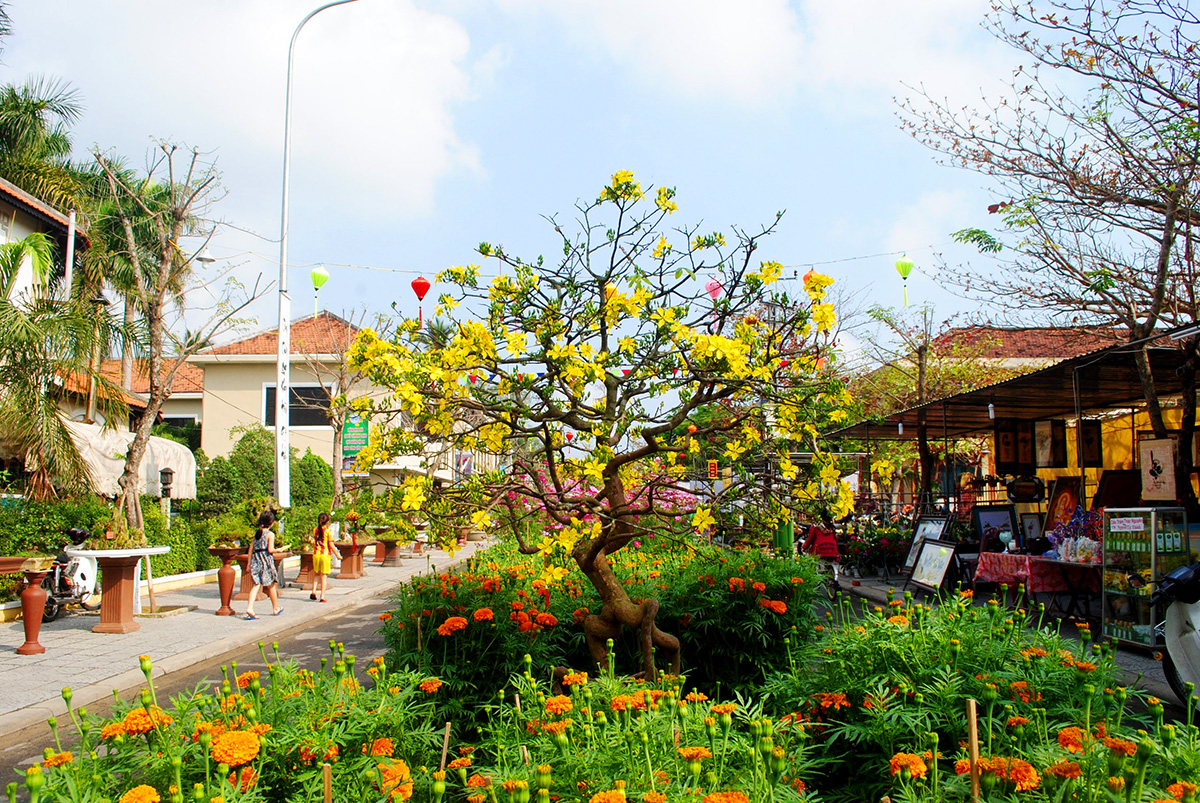
Apricot Blossoms at the Ất Mùi Lunar New Year Flower Market, Hoi An - Photo: Hồng Việt
Every year in Hội An, from the end of the eighth lunar month to the tenth lunar month, torrential rains, floods, storms, and strong winds dominate the season, followed by the cold of winter. During this time, the apricot blossom tree, like other plants in general, endures the harshness of wind and rain, appearing battered and withered. Yet afterward, once the sun returns, the apricot blossom tree becomes fresh and vigorous again, its branches and leaves lush and green. At precisely this period, usually around the Winter Solstice, people carefully pluck or strip away every single leaf until the branches are left completely bare. At that moment, the tree looks pitiable, with its leafless, thin, desolate branches. Yet the closer the year moves toward its end, the more forcefully fresh green buds emerge from the tips of those seemingly fragile golden branches. This flower seems to test its strength against the cold of winter so that, suddenly, on a dry, sunlit morning, it bursts into yellow bloom to announce that spring has arrived. Perhaps for that reason, people of the past borrowed the image of the apricot blossom to praise integrity, noble virtue, and the purity of the upright gentleman. Surely this is why a person of such character as Cao Bá Quát said that throughout his life he bowed only to the apricot blossom: “Nhất sinh đê thủ bái mai hoa” (“All my life, I bow only before the apricot blossom”).
Every year, at the end of the twelfth lunar month, all the endless worries of life seem to soften when, unexpectedly, beneath gentle rays of sunlight and a slight hint of dry seasonal wind, yellow buds begin to appear in front of someone’s house. That means Tết has arrived, and no matter how far away people may be, they try by every means possible to return home for reunion with their families. After cleaning the ancestral altar and tidying the house, no one forgets to choose a beautiful apricot blossom branch still bearing tightly closed yellow buds and place it in a large vase in the most honored place in the home to welcome the new spring. Beside the colors of the five-fruit offering tray, amid the curling incense smoke, the apricot blossom radiates an elegance full of the spirit and essence of family tradition. Those who appreciate apricot blossom also believe that the blossom symbolizes prosperity and good fortune, and that the more petals it bears, the luckier and more prosperous the family will be in the new year. As if understanding the wishes of human beings, the flower usually blooms with no fewer than five petals. The five petals of the apricot blossom are seen as representing the five gods of good fortune and the ngũ phúc, the “five blessings” (happiness, prosperity, longevity, health, and peace), and as a symbol of long life. For that reason, at the beginning of the year, when visiting homes to offer Tết greetings, one should not forget to admire and praise the beauty of the apricot blossom branch. That is considered the most meaningful and refined blessing one can offer to the host.
Apricot blossom ai is also a familiar subject in many art forms from past to present, especially as a decorative motif in the architecture of Hội An’s old townhouses. The forms in which apricot blossom appears are varied: sometimes it is simply a blooming flower combined with decorative background motifs such as võng-eye patterns, honeycomb patterns, or longevity symbols; sometimes it appears as an aged apricot blossom tree beside a rock formation; sometimes it becomes a lively pictorial composition in the motif of mai and birds, or is paired with bamboo as a symbol of the deep affection between lovers, expressed in the pairing “trúc - mai” (bamboo and apricot blossom). In addition, the most common decorative forms include apricot blossom transformed into dragons, hybridized motifs with dragons or phoenixes, or its inclusion within the “four seasons” set of mai, lotus, chrysanthemum, and bamboo, or the “four noble plants” set of mai, orchid, chrysanthemum, and pine. In these contexts, apricot blossom is not merely a flower symbolizing beauty, but also a symbol of auspiciousness and of many cherished hopes and aspirations, belonging not only to noble households but to all families.
It should also be added that, in reality, the apricot blossom (梅) is a flowering tree whose scientific name is Prunus mume Siebold & Zucc. There are many varieties, and perhaps each region tends to observe and generalize its beauty according to local perceptions. For that reason, the image of apricot blossom in Chinese visual art is not necessarily the same as the yellow apricot blossom (hoàng mai) or white apricot blossom (bạch mai) commonly seen in Hội An or throughout central and southern Vietnam. For example, in symbolic terms, the “four seasons” set in Chinese culture consists of peony, lotus, chrysanthemum, and apricot blossom, representing spring, summer, autumn, and winter respectively, and in that grouping, apricot blossom for the Han Chinese symbolizes winter. Similarly, in the grouping known as the “three friends,” the companions who remain together amid snow and frost are apricot blossom, pine, and bamboo. These forms of symbolic expression do not appear in the “four seasons” decorative program of sculpture and carved architectural ornament in Hội An.
In the past, during the days approaching Tết, people selected apricot blossom trees with abundant new shoots, plentiful blossoms, and a fresh appearance in order to cut branches and bring them to market for sale. In recent years, however, artisans have also shaped apricot blossom into ornamental bonsai-style forms by selecting large, gnarled branches with rough, mottled bark and naturally beautiful forms from old apricot blossom trees, wrapping soil around them, air-layering them to produce roots, then sawing them off and planting them in pots. These are then carefully cultivated and shaped for sale or rented out to those who enjoy displaying and appreciating apricot blossom during Tết. Even so, naturally grown apricot blossom trees planted in household gardens by great-grandfathers or grandfathers, or the custom of displaying cut apricot blossom branches, still possess their own distinct meaning, value, and charm that cannot truly be replaced.
Indeed, with the speed of urbanization and intense urban development today, many old apricot blossom trees in household gardens, and even entire apricot blossom gardens, are gradually disappearing. Surely, we will feel that the fragrance and spirit of spring have faded somewhat if, one day, Tết arrives and every household no longer has a single branch of apricot blossom on display.
Author: Nguyễn Chí Trung
Source: Hoi An Center for the Conservation of World Cultural Heritage
Newer articles
Older articles