Hoi An World Cultural Heritage Conservation Center
Events Related to Historic Monuments in Hội An in the Year of the Dragon
Among the twelve zodiac animals corresponding to the Twelve Earthly Branches (Thập nhị Địa chi: Tý, Sửu, Dần, Mão, Thìn, Tỵ, Ngọ, Mùi, Thân, Dậu, Tuất, Hợi) in the traditional cultural worldview of the Vietnamese people, the dragon (Thìn, Sino-Vietnamese: Long) occupies the fifth position. It is a mythical creature and one of the Four Sacred Creatures (Tứ linh: dragon, kylin, turtle, phoenix). In the lunar calendar, the third month is the Month of the Dragon. Dragon months and Dragon years, according to the Heavenly Stems and Earthly Branches system, include: Giáp Thìn, Bính Thìn, Mậu Thìn, Canh Thìn, and Nhâm Thìn. Each sexagenary cycle lasts sixty years (Lục thập hoa giáp). The Year of the Wood Dragon (Giáp Thìn) 2024 runs from 10 February 2024 to 28 January 2025 in the Gregorian calendar.
At Hội An’s historic monuments, references to the dragon and Dragon years appear not only in stone and wood carvings, decorative reliefs, and sacred architectural spaces such as altars, screen walls, and roof structures, with motifs such as fish and dragon playing in water, dragon-horse bearing the River Diagram, two dragons contesting a pearl, and two dragons facing the sun, but also in many historical events that took place in Dragon years, including the construction or restoration of monuments and the donation of ritual objects and sacred furnishings.
The monument Quan Công Temple (commonly known as Chùa Ông) is an early religious architectural work in Hội An and possesses outstanding values in architecture, art, and spiritual belief culture. The site still preserves more than thirty horizontal lacquered boards (hoành phi) and many pairs of Sino-Nôm parallel sentences (liễn đối) of literary and artistic significance. Among them are many boards and couplets that were created or donated in Dragon years, such as the horizontal board Trung thiên nhật nguyệt (As Bright as the Sun and Moon), established in the Giáp Thìn year of the Qianlong reign (1784); Linh uy diệu ứng (Miraculous and Sacred Power), established in the spring of Bính Thìn (1856); Nghĩa trùng thiên (Righteousness Fills the Heavens), established on an auspicious day at the beginning of spring; and Trạch cập thánh ân (Sacred Grace Extends Everywhere), established on an auspicious day in the autumn of Nhâm Thìn (1892).
In Giáp Thìn (1904), many horizontal boards were created and presented to commemorate the completion of restoration works at Quan Công Temple, including Nghĩa khí (Spirit of Righteousness), respectfully donated by merchants of the Quỳnh Phủ congregation; Thốn tâm đan thành (A Wholehearted Sincere Heart); Chính khí trường tồn (Righteous Spirit Endures Forever); Hạo khí lăng tiêu (Lofty Spirit Reaches the Clouds), donated by merchants of the Quảng Triệu congregation; Hạo nhiên chính khí (Vast and Upright Spirit), donated by the Gia Ứng congregation; Vạn cổ tinh trung (Loyalty for Ten Thousand Ages), donated by merchants of the Fujian congregation; and Hiệp thiên cung (Palace in Accord with Heaven), donated by the Five Congregations Assembly Hall.
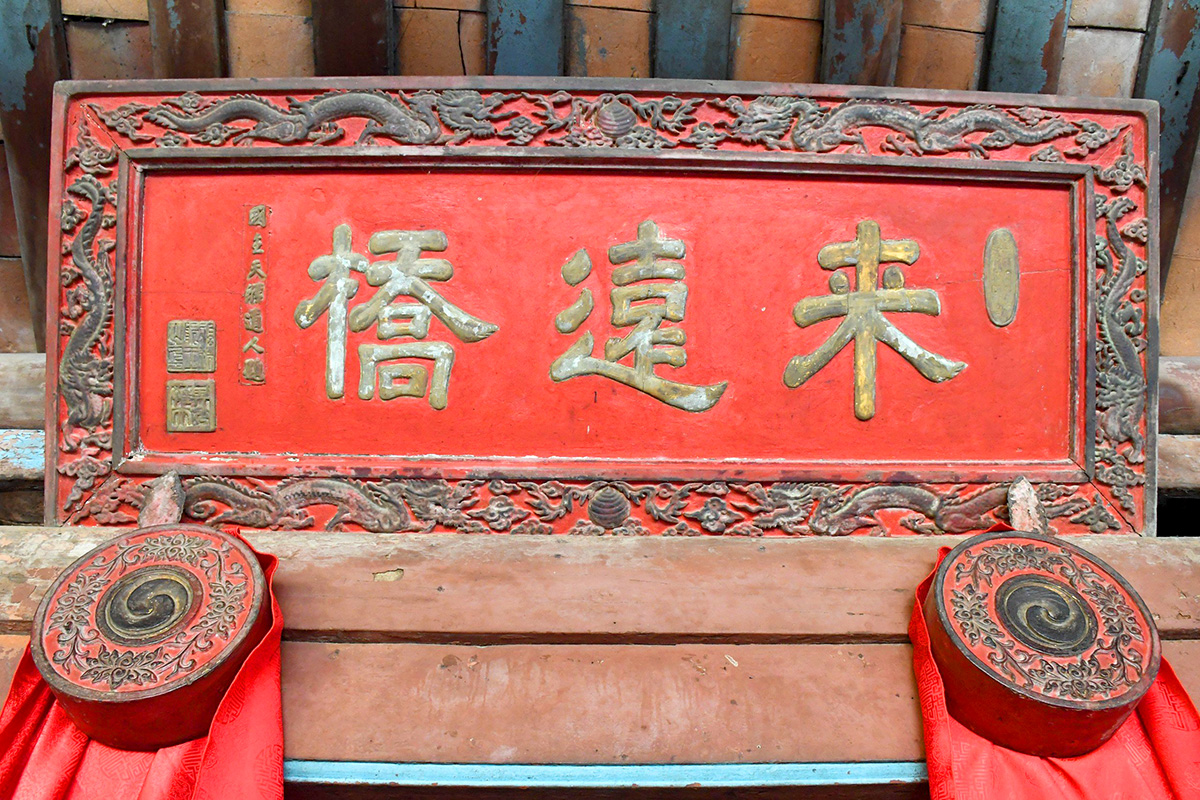
Photo: Hồng Việt
As for parallel sentences, notable examples include the pair:
(A crimson loyal heart remains in Northern history; A thousand autumns of righteous spirit strengthen the Southern realm), established in the fourth year of the Thiệu Trị reign, corresponding to Giáp Thìn (1844), and donated by District Magistrate Trương Tăng Diễn; and the pair: Tồn tín nghĩa thần ân quảng đại; Lạc xuân thu hạo khí lưu quang (Preserving faith and righteousness, divine grace spreads wide; Through spring and autumn, noble spirit shines on), donated by Hứa Trường Thắng in Giáp Thìn (1904).
At the monument Tụy Tiên Hall of the Minh Hương community, there is a stone stele erected in the second year of the Duy Tân reign (1908), composed by Trương Đồng Hiệp, a licentiate from Minh Hương village, and edited by Hà Đình Nguyễn Thuật, holder of the phó bảng degree. The inscription records that Tụy Tiên Hall was originally built in Canh Thìn (1820) at the location where Minh Hương Văn Chỉ stands today, and was only later relocated to its present site in the seventeenth year of the Thành Thái reign (1905). The inscription includes the passage: “Minh Mạng nguyên niên kiến Tiền hiền từ, ngạch viết Tụy Tiên đường…” (In the first year of Minh Mạng, a shrine to the Former Sages was established, bearing the title Tụy Tiên Hall…)
In Mậu Thìn (1868), the Temple of the Pottery Craft Ancestors of Nam Diêu in Thanh Hà village was constructed. It is one of the four shrines that make up the Nam Diêu Pottery Ancestral Temple Complex today, comprising the Pottery Craft Ancestors Temple, the Thái Giám Shrine, the Âm Linh Shrine, and the Sơn Tinh Shrine. The Pottery Craft Ancestors Temple was restored in 1893, 1933, and 1997. It faces southwest and follows a front hall - rear sanctuary layout, with the entrance designed in the form of an arched opening. Inside, the temple worships Thiên Công, the Five Elements, the Earth Deity, and the Former and Later Sages of Nam Diêu hamlet.
Also in Mậu Thìn (1868), Minh Hương Văn Chỉ, now located at 20 Phan Châu Trinh Street, was completed to worship Confucius, the Four Correlates, the Seventy-Two Sages, and the degree-holding scholars of Minh Hương village. A stele inscription at the site, written by Đặng Huy Trứ, records that the monument was first initiated in Đinh Mão (1867) and completed in Mậu Thìn (1868).
In Nhâm Thìn (1892), Chúc Thánh Pagoda was restored and an additional Rear Patriarch Hall (Hậu tổ) was constructed. Chúc Thánh Pagoda is an ancient pagoda in Hội An that was granted an imperial title (Sắc tứ). It was founded by Zen Master Minh Hải around the late seventeenth to early eighteenth century and serves as the ancestral monastery of the Lâm Tế Chúc Thánh Zen lineage in southern Vietnam. A restoration stele erected in Ất Mão under the Duy Tân reign (1915) records that: “In the Nhâm Thìn year of the Thành Thái reign (1892), the abbot Quảng Viên (from Duy Xuyên district) renovated the complex and made it more beautiful. In Giáp Ngọ of the Thành Thái reign (1894), the chief monk Chứng Đạo and deputy monk Quảng Đạt, both from Duy Xuyên district, carried out further repairs.”
Also in Nhâm Thìn (1892), many horizontal boards and parallel sentences were donated to the Five Congregations Assembly Hall and the Hainan Assembly Hall. At the Five Congregations Assembly Hall, there is the horizontal board Ân tứ quảng triệu (Grace Bestowed Far and Wide), donated by merchants of the Quảng Triệu congregation in Huế; Công bất Vũ Hạ (Merit Not Inferior to King Yu), donated by the Vinh Thành and Tài Nguyên establishments; and the couplet: Linh điểu lai thời hoành hải kình ba thiên đảo tịnh; Từ vân quá xứ kiêm thiên ngạc lãng nhất bồng bình (When sacred birds arrive, the vast sea and surging waves calm a thousand islands; When auspicious clouds pass by, the high heavens and strong winds quiet a solitary mountain), donated by Thăng Phong of the Quỳnh Phủ congregation.
At the Hainan Assembly Hall, there is the couplet: Khí tụ nhi thân, giả vi thần, tùng cổ anh linh, đa do oan phẫn; Đức thi ư nhân, tắc nghi tự, huống đồng tang tử, hựu tại địa hương (When spirit gathers and becomes divine, many heroic souls since ancient times have arisen from grievance and injustice; When virtue is extended to humanity, it is fitting to build a shrine, especially for compatriots who perished far from home), donated by the merchants Phan Thiên Liêm, Phan Tiên Tường, Hàn Nhân Phong, Hồng Dĩ Cẩm, Trịnh Đình Côn, and Đặng Hoán Giai.
Today, at An Mỹ Communal House in Cẩm Châu, two horizontal boards created and donated in Dragon years are still preserved. These include Phổ đức Nam thiên (Virtue Spreads Across the Southern Heavens), established by the local community in the fourth year of Thiệu Trị, corresponding to Giáp Thìn (1844), and Chiêu Tiền Liệt (Honouring the Worthies of Former Generations), donated by the Nguyễn Đức lineage, one of the Former Sage lineages of An Mỹ village, in Giáp Thìn (1904).
At Cẩm Phô Văn Chỉ, there remains the horizontal board Văn Thánh miếu (Temple of Literature), established in Canh Thìn, the fifteenth year of the Bảo Đại reign (1940), and donated by Nguyễn Tường Long, a Proofreader of the Hanlin Academy.
Beyond these events directly related to historic monuments in Hội An, many other documentary sources and events concerning Hội An were either recorded or took place in Dragon years. These include the “Phổ Đà Sơn Linh Trung Phật” stele at Hoa Nghiêm Cave in the Ngũ Hành Sơn complex, erected in Canh Thìn (1640) and containing records of Japanese people in Hội An; and the introduction of Catholicism into Vietnam through the arrival of the Jesuit mission in Hội An in Bính Thìn (1616).
Author: Hồng Việt
Source: Hoi An Center for the Conservation of World Cultural Heritage
Newer articles
Older articles