Hoi An World Cultural Heritage Conservation Center
The Whale Cult (Cá Ông) in the Belief Life of Coastal Communities in Đà Nẵng in the Contemporary Context
In the course of Vietnamese history, Đà Nẵng has functioned not only as a geographical space but also as a site marking early stages of the southward expansion (Nam tiến) of the Vietnamese people. Following the political marriage between King Chế Mân and Princess Huyền Trân in 1306, migration from the North intensified, contributing to the formation and shaping of local populations.
In this once harsh and disease-ridden environment (“sơn lam chướng khí”, referring to mountainous forests associated with miasma and hardship), settlers not only developed agriculture but also adapted flexibly to maritime conditions. This led to the emergence of traditional coastal fishing communities. Today, Đà Nẵng has more than 37 fishing villages distributed along over 215 km of coastline, from the foot of Hải Vân Pass to the south of Núi Thành. These villages, formed over centuries, sustain rich material and spiritual lives with distinctive belief systems. Prominent among them is the whale cult (tín ngưỡng thờ Cá Ông), expressing faith, gratitude, and an intimate relationship between humans and the sea.
This belief originates from the precarious living conditions of seafaring communities, who constantly face unpredictable natural dangers. In this context, whales are believed to rescue people in distress at sea and are therefore venerated under respectful titles such as Ông, Cá Ông, Ông Chuông, Ông Ngư, Ông Kình, and Ngài[1]. These appellations reflect a process of sacralization, elevating a natural species into a revered spiritual entity. This can be understood as a form of “anthropomorphizing nature”, whereby humans attribute supernatural power and moral value to natural phenomena to establish harmony with their environment.
The whale cult is not confined to folk belief but was also recognized by the imperial court. The historical record Đại Nam thực lục notes: “Whales are large sea creatures that often rescue people, hence called ‘Nhân ngư’ (benevolent fish).” Based on this perception, the court provided financial support and ceremonial burial when whales washed ashore, and conferred royal titles of varying ranks. These include honorifics such as Nam Hải Cự Tộc Ngọc Lân chi thần (Nam Ô fishing village), Đông Hải Ngọc Lân tôn thần (Thanh Khê), Nam Hải Cự Tộc Đại tướng quân (Tân Trà shrine), Đông Hải Cự Tộc Ngọc Lân Thượng đẳng thần (Mỹ Khê), Ngọc Lân Nam Hải Cự Tộc (Tiêu Diện shrine), Nam Hải Cự Tộc Ngọc Lân tôn thần (An Bàng shrine).
The persistence of this belief is closely associated with a network of sacred spaces, notably whale temples (lăng Ông) located across coastal fishing villages. In Đà Nẵng, such sites exist in Nam Ô, Thanh Khê, Nại Hiên Đông, Nam Thọ, Tân Thái, Mỹ Khê, Tân Trà, Duy Vinh, Bình Tân, Bình Dương, and Nam Hải (former Tam Thanh commune). In Hội An, there are six such sites in An Bàng, Tân Thành, Cửa Đại, Cẩm Nam, Cẩm Thanh, and Cù Lao Chàm.
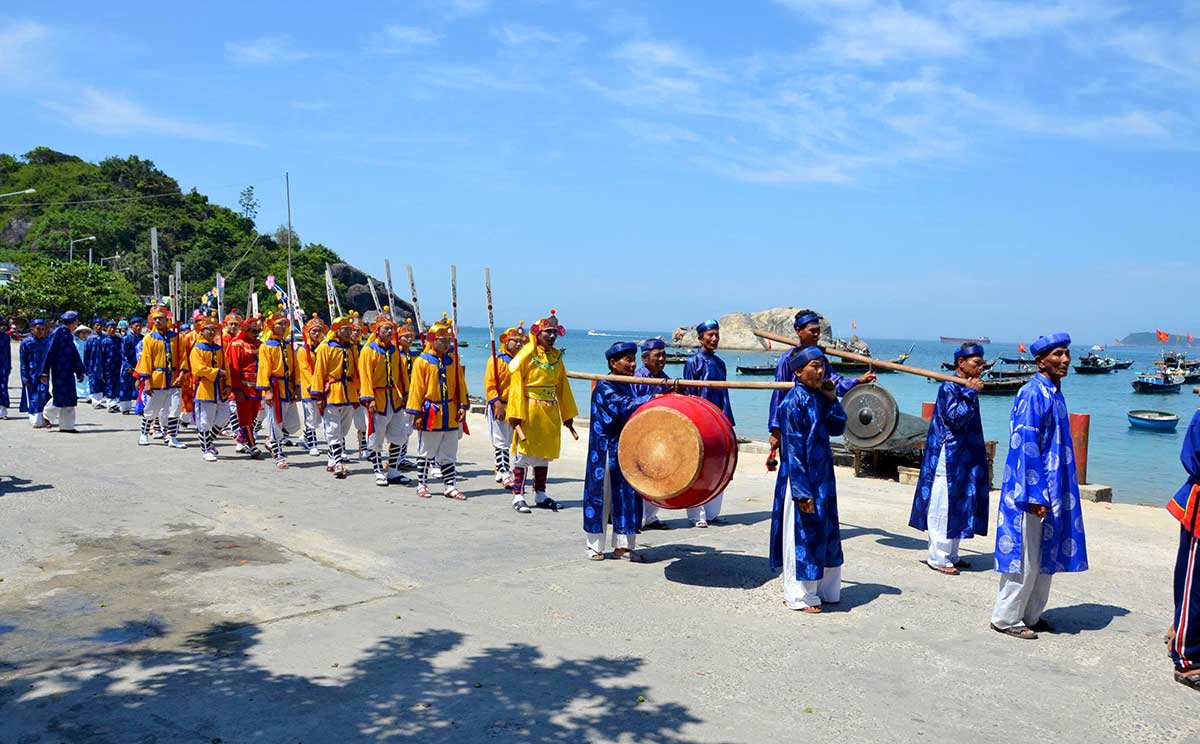
Beyond belief, whale worship constitutes a community cultural institution, expressed through rituals and festivals, most notably the Cầu Ngư festival (Whale Worship/Fishing Prayers Festival). In Đà Nẵng, this festival is typically held in early spring after the Lunar New Year, with specific dates varying by locality: An Bàng Whale Temple (lăng Ông An Bàng, 15th day of the First Lunar Month); Thanh Khê Whale Temple (lăng Ông Thanh Khê, 17th–20th days of the First Lunar Month); Tân Thành Whale Temple (lăng Ông Tân Thành, 11th–12th days of the Second Lunar Month); Nam Ô Whale Temple (lăng Ông Nam Ô, 14th–16th days of the Second Lunar Month); Tiêu Diện Whale Temple, Cửa Đại (lăng Tiêu Diện Cửa Đại, 15th–17th days of the Second Lunar Month); Duy Vinh Whale Temple (lăng Ông Duy Vinh, 16th day of the Second Lunar Month); Vạn Đồng Hiệp Whale Temple (lăng Ông Vạn Đồng Hiệp, 16th–18th days of the Second Lunar Month); Nam Thọ Whale Temple (lăng Ông Nam Thọ, 26th day of the Second Lunar Month); Bình Hải Whale Temple (lăng Ông Bình Hải, 15th day of the Third Lunar Month); Ngư Whale Temple, Cù Lao Chàm (lăng Ông Ngư Cù Lao Chàm, 3rd–4th days of the Fourth Lunar Month); etc.
Although dates differ, most festivals occur in spring, symbolizing renewal and hope. This timing also coincides with the beginning of the southern fishing season (vụ cá nam[4]), aligning ritual practice with the ecological and economic rhythms of coastal life. The festival functions both as an act of remembrance and gratitude toward the Whale Deity (Đức Ngư Ông) and as a ritual opening of the fishing season, expressing wishes for calm seas, favorable weather, and abundant catches. It also reflects accumulated ecological knowledge, as fishermen determine optimal fishing periods through long-term observation.
Overall, the whale worship belief (tín ngưỡng thờ Cá Ông) and the Cầu Ngư festival play an important role in the spiritual life of coastal fishing communities in Đà Nẵng in general and the Hội An area in particular, and can be examined from multiple perspectives. First, as the festival is held at the beginning of the year, it coincides with a time when people orient themselves toward positive aspirations and new beginnings; therefore, prayers for peace, prosperity, and good fortune become common needs. For fishermen, this holds even greater significance, as seafaring inherently involves many dangers. The festival thus functions as a kind of “spiritual remedy,” helping them maintain confidence before each voyage. Economically, it marks the beginning of a new fishing cycle, contributing to the regulation of community rhythms and activities. The Cầu Ngư festival is also an opportunity for members of fishing villages to gather, strengthen social bonds, and reaffirm communal identity.
Alongside the development of modern society, the organization of the Cầu Ngư festival varies in scale across localities depending on available resources and conditions. However, in general, the whale worship belief and the Cầu Ngư festival in Đà Nẵng, especially in fishing villages located within the cultural space of Hội An Ancient Town, have been preserved almost intact in both scale and form. Field surveys at Tiêu Diện Tứ Chánh Vạn Whale Temple (Phước Hải residential quarter, Hội An Đông ward) show that the whale worship belief continues to be maintained with a relatively complete ritual structure. The Cầu Ngư ceremony here is conducted with the participation of a large number of local residents, with village elders serving as ritual leaders. The rites are performed according to tradition, with minimal intervention from modern performative elements. In several villages such as Nam Ô, Tân Thái, and Nam Thọ, and especially in Tân Thành, Bình Minh, and Tam Thanh, despite the rapid development of tourism and urbanization, the belief system has retained its core elements. Although the number of visitors has increased, ritual spaces are still protected by the community as sacred zones, limiting intrusion by commercial activities.
In general, the whale worship belief and the Cầu Ngư festival are the result of a long process of human adaptation to the marine environment, while also reflecting how coastal communities interpret and engage with nature. From a folk belief, this system has developed into a structured set of cultural practices sustained across generations. In the face of urbanization and the rapid transformations of modern society, ritual practices will inevitably undergo certain changes; nevertheless, it can be affirmed that the symbolic figure and worship of the whale continue to be preserved and promoted in their inherent values, making an important contribution to the distinctive cultural identity of Đà Nẵng as a whole and Hội An in particular.
This belief originates from the precarious living conditions of seafaring communities, who constantly face unpredictable natural dangers. In this context, whales are believed to rescue people in distress at sea and are therefore venerated under respectful titles such as Ông, Cá Ông, Ông Chuông, Ông Ngư, Ông Kình, and Ngài[1]. These appellations reflect a process of sacralization, elevating a natural species into a revered spiritual entity. This can be understood as a form of “anthropomorphizing nature”, whereby humans attribute supernatural power and moral value to natural phenomena to establish harmony with their environment.
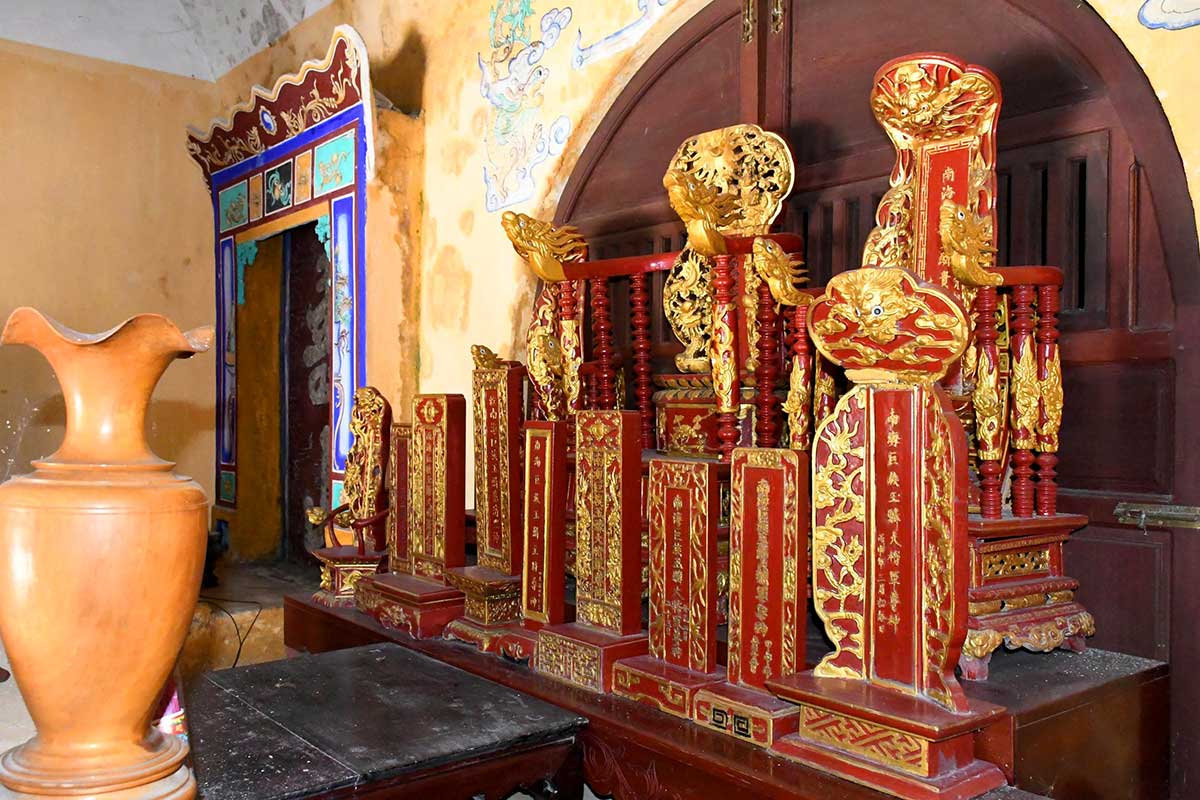
Spirit Tablets at Ong Ngu Temple, Cham Islands
The whale cult is not confined to folk belief but was also recognized by the imperial court. The historical record Đại Nam thực lục notes: “Whales are large sea creatures that often rescue people, hence called ‘Nhân ngư’ (benevolent fish).” Based on this perception, the court provided financial support and ceremonial burial when whales washed ashore, and conferred royal titles of varying ranks. These include honorifics such as Nam Hải Cự Tộc Ngọc Lân chi thần (Nam Ô fishing village), Đông Hải Ngọc Lân tôn thần (Thanh Khê), Nam Hải Cự Tộc Đại tướng quân (Tân Trà shrine), Đông Hải Cự Tộc Ngọc Lân Thượng đẳng thần (Mỹ Khê), Ngọc Lân Nam Hải Cự Tộc (Tiêu Diện shrine), Nam Hải Cự Tộc Ngọc Lân tôn thần (An Bàng shrine).
The persistence of this belief is closely associated with a network of sacred spaces, notably whale temples (lăng Ông) located across coastal fishing villages. In Đà Nẵng, such sites exist in Nam Ô, Thanh Khê, Nại Hiên Đông, Nam Thọ, Tân Thái, Mỹ Khê, Tân Trà, Duy Vinh, Bình Tân, Bình Dương, and Nam Hải (former Tam Thanh commune). In Hội An, there are six such sites in An Bàng, Tân Thành, Cửa Đại, Cẩm Nam, Cẩm Thanh, and Cù Lao Chàm.
Ritual Spirit Procession during the Whale Worship Festival at Ong Ngu Temple, Cham Islands
Particularly at the whale temple in Cù Lao Chàm, 12 intricately carved wooden spirit tablets are preserved, bearing titles such as Nam Hải Cự Tộc Ngọc Lân Đại tướng quân tôn thần and Nam Hải Cự Tộc Ngọc Lân Từ Tế chi thần[2][3]. These titles, conferred by the Nguyễn dynasty, demonstrate not only reverence but also the formalization of the belief into a structured and institutionalized religious system in which the whale is regarded as a multifaceted deity: rescuer, protector, and enduring object of communal veneration.Beyond belief, whale worship constitutes a community cultural institution, expressed through rituals and festivals, most notably the Cầu Ngư festival (Whale Worship/Fishing Prayers Festival). In Đà Nẵng, this festival is typically held in early spring after the Lunar New Year, with specific dates varying by locality: An Bàng Whale Temple (lăng Ông An Bàng, 15th day of the First Lunar Month); Thanh Khê Whale Temple (lăng Ông Thanh Khê, 17th–20th days of the First Lunar Month); Tân Thành Whale Temple (lăng Ông Tân Thành, 11th–12th days of the Second Lunar Month); Nam Ô Whale Temple (lăng Ông Nam Ô, 14th–16th days of the Second Lunar Month); Tiêu Diện Whale Temple, Cửa Đại (lăng Tiêu Diện Cửa Đại, 15th–17th days of the Second Lunar Month); Duy Vinh Whale Temple (lăng Ông Duy Vinh, 16th day of the Second Lunar Month); Vạn Đồng Hiệp Whale Temple (lăng Ông Vạn Đồng Hiệp, 16th–18th days of the Second Lunar Month); Nam Thọ Whale Temple (lăng Ông Nam Thọ, 26th day of the Second Lunar Month); Bình Hải Whale Temple (lăng Ông Bình Hải, 15th day of the Third Lunar Month); Ngư Whale Temple, Cù Lao Chàm (lăng Ông Ngư Cù Lao Chàm, 3rd–4th days of the Fourth Lunar Month); etc.
Although dates differ, most festivals occur in spring, symbolizing renewal and hope. This timing also coincides with the beginning of the southern fishing season (vụ cá nam[4]), aligning ritual practice with the ecological and economic rhythms of coastal life. The festival functions both as an act of remembrance and gratitude toward the Whale Deity (Đức Ngư Ông) and as a ritual opening of the fishing season, expressing wishes for calm seas, favorable weather, and abundant catches. It also reflects accumulated ecological knowledge, as fishermen determine optimal fishing periods through long-term observation.
Overall, the whale worship belief (tín ngưỡng thờ Cá Ông) and the Cầu Ngư festival play an important role in the spiritual life of coastal fishing communities in Đà Nẵng in general and the Hội An area in particular, and can be examined from multiple perspectives. First, as the festival is held at the beginning of the year, it coincides with a time when people orient themselves toward positive aspirations and new beginnings; therefore, prayers for peace, prosperity, and good fortune become common needs. For fishermen, this holds even greater significance, as seafaring inherently involves many dangers. The festival thus functions as a kind of “spiritual remedy,” helping them maintain confidence before each voyage. Economically, it marks the beginning of a new fishing cycle, contributing to the regulation of community rhythms and activities. The Cầu Ngư festival is also an opportunity for members of fishing villages to gather, strengthen social bonds, and reaffirm communal identity.
Alongside the development of modern society, the organization of the Cầu Ngư festival varies in scale across localities depending on available resources and conditions. However, in general, the whale worship belief and the Cầu Ngư festival in Đà Nẵng, especially in fishing villages located within the cultural space of Hội An Ancient Town, have been preserved almost intact in both scale and form. Field surveys at Tiêu Diện Tứ Chánh Vạn Whale Temple (Phước Hải residential quarter, Hội An Đông ward) show that the whale worship belief continues to be maintained with a relatively complete ritual structure. The Cầu Ngư ceremony here is conducted with the participation of a large number of local residents, with village elders serving as ritual leaders. The rites are performed according to tradition, with minimal intervention from modern performative elements. In several villages such as Nam Ô, Tân Thái, and Nam Thọ, and especially in Tân Thành, Bình Minh, and Tam Thanh, despite the rapid development of tourism and urbanization, the belief system has retained its core elements. Although the number of visitors has increased, ritual spaces are still protected by the community as sacred zones, limiting intrusion by commercial activities.
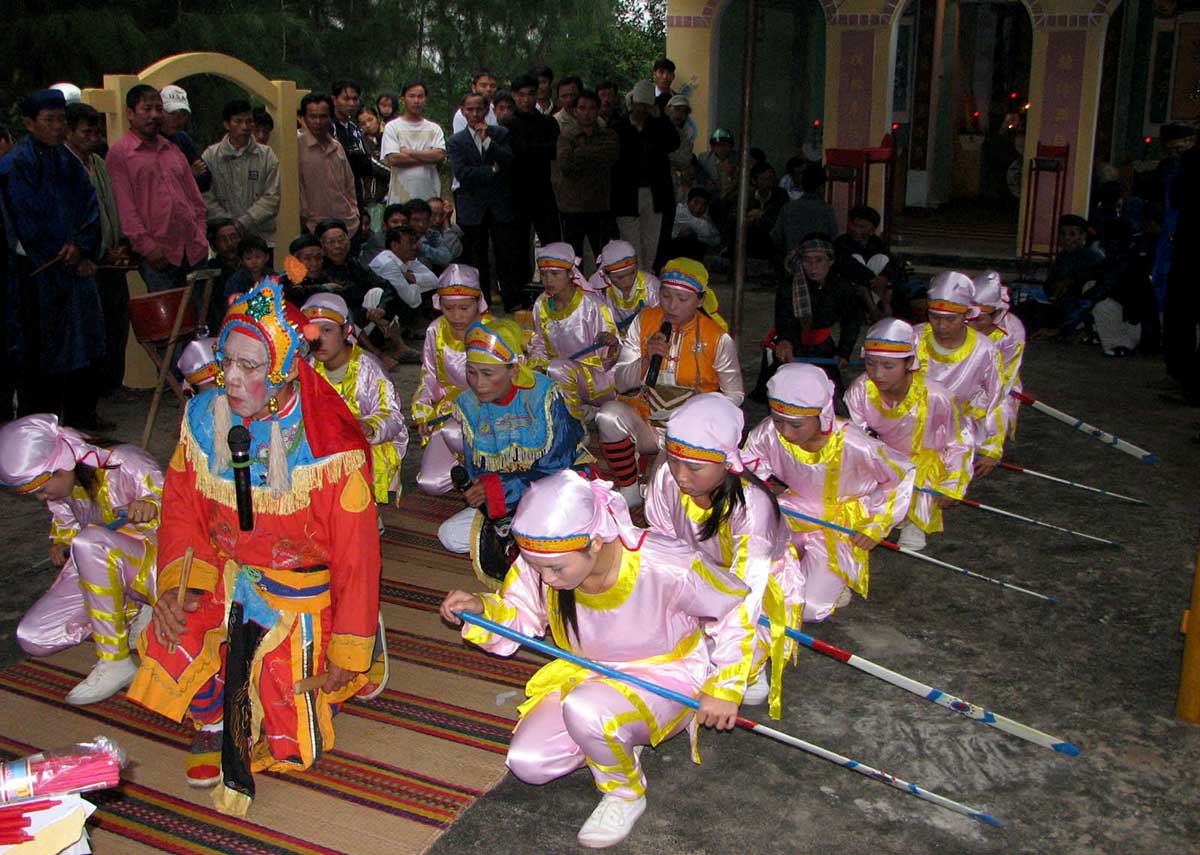
Ba Trao Singing Performance at the Whale Worship Festival in An Bang
More broadly, across the city, the system of fishing villages stretching along the coast has generally preserved this belief relatively well, although the degree of transformation varies depending on the socio-economic conditions of each locality. However, in recent years, alongside the growth of coastal tourism, some localities have organized the Cầu Ngư festival on a larger scale, with rituals staged in marine spaces to create attractions for visitors. While this approach contributes to promoting local cultural images, it also alters the traditional structure of the rituals. This process of “theatricalization” risks diminishing the inherent sacredness of the rituals, as performative elements begin to overshadow their spiritual functions. This raises the challenge of balancing cultural preservation and promotion with economic development. In practice, in many fishing villages, local communities still retain a central role in determining how rituals are conducted. As long as people continue to maintain belief and practice in their daily lives, core cultural values remain capable of being preserved.In general, the whale worship belief and the Cầu Ngư festival are the result of a long process of human adaptation to the marine environment, while also reflecting how coastal communities interpret and engage with nature. From a folk belief, this system has developed into a structured set of cultural practices sustained across generations. In the face of urbanization and the rapid transformations of modern society, ritual practices will inevitably undergo certain changes; nevertheless, it can be affirmed that the symbolic figure and worship of the whale continue to be preserved and promoted in their inherent values, making an important contribution to the distinctive cultural identity of Đà Nẵng as a whole and Hội An in particular.
[1] Trần Ngọc Vinh, Nam Ô fishing village.
[2] Nguyễn Cường (2023), Sites associated with the whale worship practice in Hội An, https://hoianheritage.net/vi/trao-doi-chuyen-nganh/chuyen-de-nghien-cuu-trao-doi/cac-di-tich-lien-quan-den-tuc-tho-cung-ca-ong-o-hoi-an-1118.html, accessed April 4, 2026.
[3] Heritage Documentation and Information Department (2024), The whale worship belief in Hội An, https://hoianheritage.net/vi/trao-doi-chuyen-nganh/chuyen-de-nghien-cuu-trao-doi/tin-nguong-tho-cung-ca-ong-o-hoi-an-1212.html, accessed April 4, 2026.
[4] T.V.T., temple caretaker (ông từ) of Nam Thọ Whale Temple.
Author: Đoàn Cẩm Giang
Source: Hoi An Center for the Conservation of World Cultural Heritage
Newer articles
Older articles