Hoi An World Cultural Heritage Conservation Center
The Influence of Confucianism on Traditional Domestic Architecture in Hội An
Confucianism was introduced into Vietnam at a very early stage, endured for centuries, and left a profound imprint on many aspects of social life during the feudal period. Beyond its emphasis on the tradition of learning and its veneration of degree holders and scholarly achievement, Confucianism also shaped moral standards, promoted reverence for teachers, elevated the virtues of the gentleman-scholar, and prescribed patterns of conduct both within the family and in society at large.
In Hội An, the influence of Confucianism is reflected quite clearly in both cultural life and traditional architecture. Among the built heritage of the city, its influence is most visibly expressed in sites dedicated to the worship of Confucius and local degree holders that still survive in present-day Hội An Ward, namely Minh Hương Literary Shrine (20 Phan Châu Trinh Street), Cẩm Phô Văn Thánh Temple (32 Hùng Vương Street), and the Temple of Confucius (122 Trần Hưng Đạo Street). These are not merely places that honor learning, but also enduring expressions of the local community’s respect for knowledge, ritual propriety, and moral cultivation across generations.
Within the spaces of family houses and ancestral halls, this influence becomes even more intimate and recognizable, for “codes of conduct within the family were highly valued and carefully observed by the people of Hội An, and the moral values of Confucian thought were taught and instilled by elders from the time children were newly born until adulthood[1].”
In the travel writings of Camille Paris, a French colonial official responsible for constructing telegraph lines from Huế to the southern provinces of Central Vietnam, published in 1889, he recorded several family customs observed in the places he passed through, such as: “When speaking to their parents, children must stand upright and maintain a respectful attitude, often with their arms folded. Even upon reaching adulthood, they are not permitted to sit on the same platform as their parents. … Within the family, sons may dine with their parents, but if guests are present, they must withdraw unless they are of sufficient age or have already been appointed to an official post. Women and girls eat elsewhere[2].” Likewise, “The role of the wife was absolutely passive; her life was bound to that of her husband. She was expected to show him the same reverence that an inferior would show to a superior[3].”
In order to enact these rituals and codes of conduct within the family sphere, the arrangement of living space inside the house, particularly in relation to gender, social rank, and age, was structured in a highly regulated way, and this also had some effect on architectural decoration. At times, such arrangements may even have created a sense of restriction for those living within them. The solemnity and stillness of Confucian spirit, which might otherwise have been reserved for ritual or religious institutions, in fact extended into domestic architecture in the Cochinchina. As a result, the warmth and openness of a more relaxed, everyday living environment, especially in central Vietnam, was in no small part affected[4]. A closer look at several aspects of traditional domestic architecture in Hội An helps make these influences more visible.
In terms of spatial arrangement, Confucian thought regarded ancestor worship as a sacred obligation that had to be carried out according to strict rules. The worship area therefore became the most solemn and important space within the house. In Hội An, nearly every family traditionally maintained an altar for ancestors and household deities. “The deities worshipped by Vietnamese folk religion in general, and by the people of Hội An in particular, within the domestic sphere, were largely influenced by the ritual system of ancient Chinese Confucianism. Thus, from shophouses in the old quarter to houses in the rural outskirts, and from Vietnamese households to Chinese ones, almost every house had a shrine cabinet for the household gods, basically consisting of a system of five deities who governed the house and land, collectively known as the Ngũ tự gia đường[5].”
Because worship space was accorded the highest priority, the ancestral altar was always placed in the most central and dignified location. In urban areas, especially within the Ancient Town, shophouses typically took the form of tube houses divided into three bays, with a central passageway, and the altar was often placed on a raised platform or on the upper floor in the principal block of a two-storey house. In rural areas, where the main house commonly followed the three-bay or three-bay-two-wing layout, the altar was usually located in the central bay. Shrine cabinets and ancestral altars were often elaborately arranged with ritual bronze sets of 3 or 5 pieces, flower offerings, and other ceremonial objects.
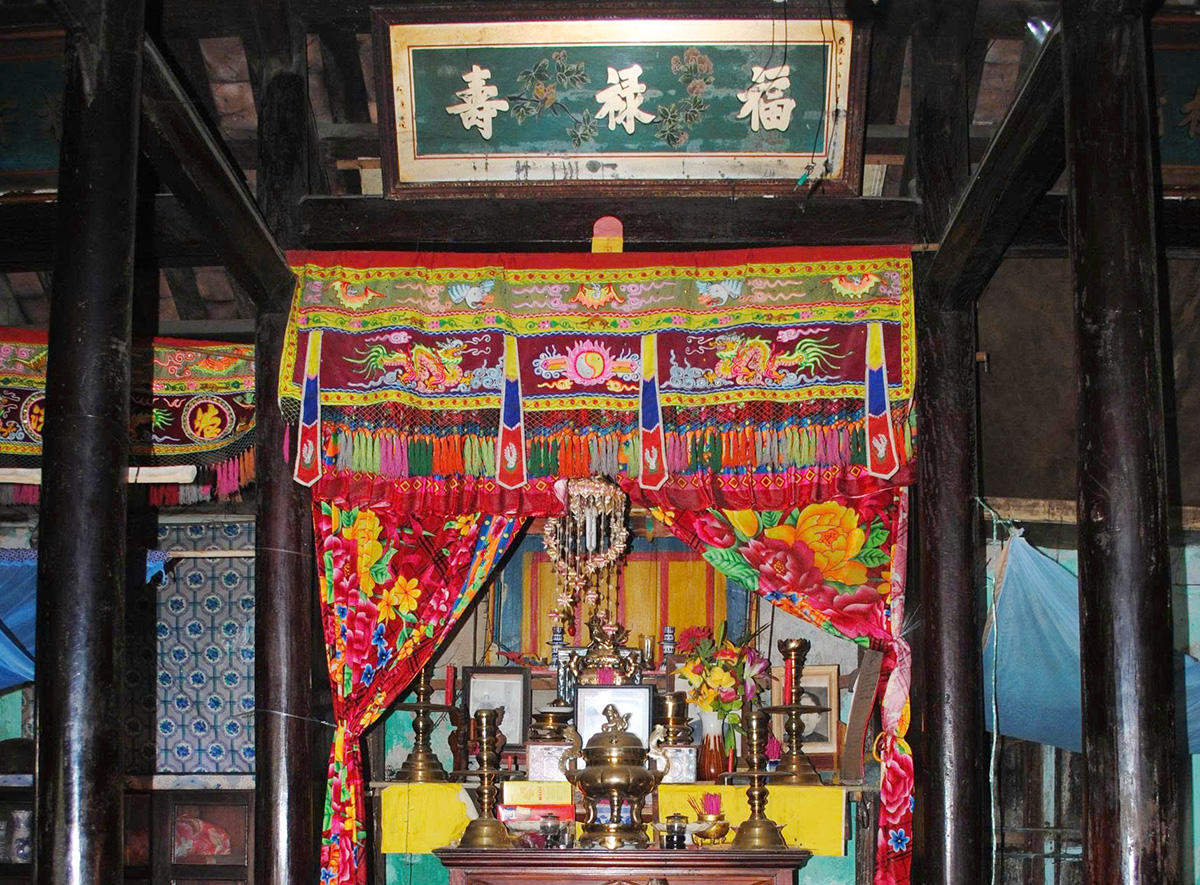
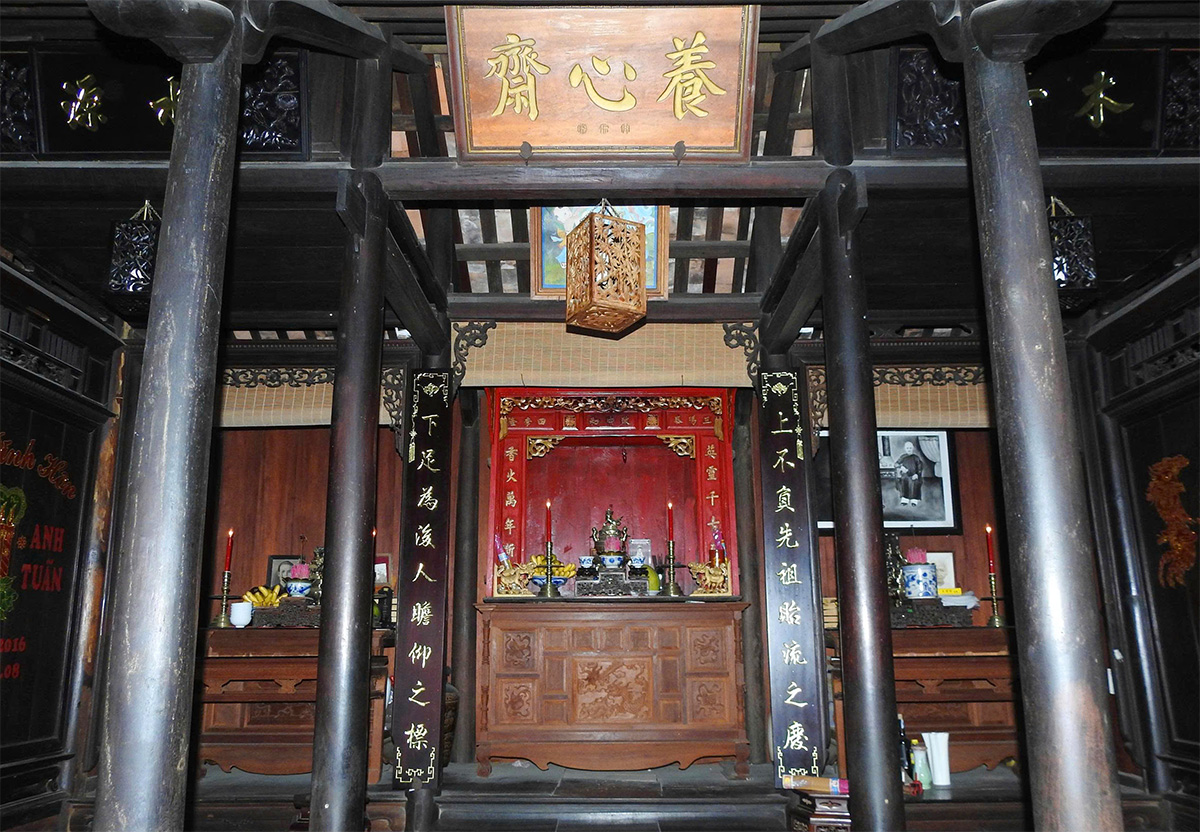
Because the worship space was considered sacred, it was important to limit direct access to or visual intrusion upon the altar. As a result, the altar was often screened by a curtain or a spirit screen. The floor level of the worship area was usually raised one step above the main floor in order to distinguish its function and reinforce its solemnity. In front of the worship bay was typically placed a reception set reserved primarily for men, namely the male head of household, senior male family members, and honored guests, while women and children were generally discouraged from using this area for everyday activity. Some houses also arranged potted ornamental plants, installed railings at the central front bay, or placed a movable screen before or behind the central doorway in order to prevent people from walking directly into the principal space or looking straight into the worship area.
The main house was thus used primarily for worship and the reception of honored guests. Women and children generally occupied their own rooms in the secondary block. This spatial organization clearly reflected ideas about belief, status, and hierarchy among family members, together with expectations regarding propriety and conduct, such as the requirement to behave solemnly and dress appropriately when entering the main worship space.
In terms of architectural ornamentation, the areas devoted to worship and formal reception were considered especially important, and therefore, as one source notes, “people tended to display their most elaborate decorations toward the visitors to the house and under the witness of the ancestral spirits[6].” The interior of the principal house block was usually the most richly decorated, with horizontal lacquered boards and parallel couplets, as well as carvings on the timber structural members such as trusses, rafters, ridge beams, brackets, and shrine furnishings. Beyond their ritual function, these decorative features also conveyed messages intended for descendants, especially through the inscriptions on horizontal plaques and antithetical couplets, some of which reveal clear Confucian influence.
With regard to decorative motifs, certain mythical creatures associated with Confucian symbolism were used on altar tables and shrine cabinets. Most common were the dragon-horse and the qilin, rendered in reference to the classical allusion “the dragon-horse bearing the River Diagram,” followed by the phoenix. According to legend, when Confucius was born, a phoenix appeared stretching its wings and flying heavenward, while a qilin was said to have been seen wandering over the nearby hills. It was also said that the final appearance of the qilin occurred shortly before Confucius’s death[7]. Another, rarer motif can be seen on the wooden partition wall of the bridge house at 77 Trần Phú Street, where two carved panels depict the “four classes of people[8],” showing characteristic scenes of a scholar reading, a woodcutter gathering firewood, a fisherman seated with his rod, and a shepherd boy leading a buffalo. This motif recalls “the stories of Jiang Ziya, Zhu Maichen, Yi Yin, and Li Mi, men of learning and integrity from antiquity who were often upheld in Vietnamese Confucian tradition as exemplary models of studiousness, perseverance, and principled conduct in both service and withdrawal[9].” On the same partition is also a carved panel of a carp leaping over the Dragon Gate, symbolizing the aspiration to achieve success, distinction, and upward transformation through scholarship and the examination system.
The couplets flanking the shrine cabinet, as well as the horizontal plaques and hanging scrolls displayed in the main house, served not only decorative purposes but also conveyed texts praising the virtues and merits of ancestors, offering moral instruction, celebrating good character, or expressing auspicious wishes. Some of these clearly bear the imprint of Confucian ideology. For instance, the wooden shrine cabinet in the historic house of Huỳnh Thị Liêu (formerly in Cẩm Kim commune) bears the Chinese couplet: “For ten thousand ages, the cardinal principles and moral norms are preserved in the brush of Master Zhu; a whole heart’s worth of feeling and principle is known to the Uncrowned King.” Previously, the house at 07 Nguyễn Thị Minh Khai[10] displayed a gilded imperial commendation board inscribed with the Chinese phrase “Tiết hạnh khả phong,” bestowed upon a woman of the Lê family in praise of her chastity and virtuous conduct, in accordance with the ideals of “Three Obediences and Four Virtues,” which were among the moral prescriptions for women in the East derived from Confucian thought.
Over time, certain notions associated with Confucianism, such as patriarchy and male preference, have come to be seen as no longer appropriate, causing its influence within collective consciousness to become less explicit. Today, although Confucian ritual codes and household etiquette are no longer strictly observed, the basic structure of worship space and the traditional arrangement of domestic architecture have remained relatively intact. In Hội An, especially in the context of the ongoing “Hội An – Hospitality and Inherent Kindness” initiative, many traditional moral values are being reconsidered in more positive ways and adapted to contemporary life. This suggests that Confucian thought, while no longer overtly present, continues to permeate everyday life and has become embedded in the community’s patterns of conduct almost naturally.
For that reason, the influence of Confucianism in the traditional houses of Hội An is not always immediately or neatly identifiable. Yet behind decorative motifs, spatial arrangements, and domestic customs still lie moral messages, social expectations, and didactic intentions entrusted by earlier generations. Although transformed over time, these values have not disappeared. Rather, they have been adjusted and reinterpreted, continuing to contribute to the preservation and enrichment of the moral and spiritual foundations of Hội An’s community today.
Sacred worship space at the Huynh Tai Old House, Hoi An Dong Ward - Photo: Hoàng Phúc
Within the spaces of family houses and ancestral halls, this influence becomes even more intimate and recognizable, for “codes of conduct within the family were highly valued and carefully observed by the people of Hội An, and the moral values of Confucian thought were taught and instilled by elders from the time children were newly born until adulthood[1].”
In the travel writings of Camille Paris, a French colonial official responsible for constructing telegraph lines from Huế to the southern provinces of Central Vietnam, published in 1889, he recorded several family customs observed in the places he passed through, such as: “When speaking to their parents, children must stand upright and maintain a respectful attitude, often with their arms folded. Even upon reaching adulthood, they are not permitted to sit on the same platform as their parents. … Within the family, sons may dine with their parents, but if guests are present, they must withdraw unless they are of sufficient age or have already been appointed to an official post. Women and girls eat elsewhere[2].” Likewise, “The role of the wife was absolutely passive; her life was bound to that of her husband. She was expected to show him the same reverence that an inferior would show to a superior[3].”
In order to enact these rituals and codes of conduct within the family sphere, the arrangement of living space inside the house, particularly in relation to gender, social rank, and age, was structured in a highly regulated way, and this also had some effect on architectural decoration. At times, such arrangements may even have created a sense of restriction for those living within them. The solemnity and stillness of Confucian spirit, which might otherwise have been reserved for ritual or religious institutions, in fact extended into domestic architecture in the Cochinchina. As a result, the warmth and openness of a more relaxed, everyday living environment, especially in central Vietnam, was in no small part affected[4]. A closer look at several aspects of traditional domestic architecture in Hội An helps make these influences more visible.
In terms of spatial arrangement, Confucian thought regarded ancestor worship as a sacred obligation that had to be carried out according to strict rules. The worship area therefore became the most solemn and important space within the house. In Hội An, nearly every family traditionally maintained an altar for ancestors and household deities. “The deities worshipped by Vietnamese folk religion in general, and by the people of Hội An in particular, within the domestic sphere, were largely influenced by the ritual system of ancient Chinese Confucianism. Thus, from shophouses in the old quarter to houses in the rural outskirts, and from Vietnamese households to Chinese ones, almost every house had a shrine cabinet for the household gods, basically consisting of a system of five deities who governed the house and land, collectively known as the Ngũ tự gia đường[5].”
Because worship space was accorded the highest priority, the ancestral altar was always placed in the most central and dignified location. In urban areas, especially within the Ancient Town, shophouses typically took the form of tube houses divided into three bays, with a central passageway, and the altar was often placed on a raised platform or on the upper floor in the principal block of a two-storey house. In rural areas, where the main house commonly followed the three-bay or three-bay-two-wing layout, the altar was usually located in the central bay. Shrine cabinets and ancestral altars were often elaborately arranged with ritual bronze sets of 3 or 5 pieces, flower offerings, and other ceremonial objects.
Worship space at the Tran Can Old House, Tan Hiep Commune - Photo: Hoàng Phúc
Because the worship space was considered sacred, it was important to limit direct access to or visual intrusion upon the altar. As a result, the altar was often screened by a curtain or a spirit screen. The floor level of the worship area was usually raised one step above the main floor in order to distinguish its function and reinforce its solemnity. In front of the worship bay was typically placed a reception set reserved primarily for men, namely the male head of household, senior male family members, and honored guests, while women and children were generally discouraged from using this area for everyday activity. Some houses also arranged potted ornamental plants, installed railings at the central front bay, or placed a movable screen before or behind the central doorway in order to prevent people from walking directly into the principal space or looking straight into the worship area.
The main house was thus used primarily for worship and the reception of honored guests. Women and children generally occupied their own rooms in the secondary block. This spatial organization clearly reflected ideas about belief, status, and hierarchy among family members, together with expectations regarding propriety and conduct, such as the requirement to behave solemnly and dress appropriately when entering the main worship space.
In terms of architectural ornamentation, the areas devoted to worship and formal reception were considered especially important, and therefore, as one source notes, “people tended to display their most elaborate decorations toward the visitors to the house and under the witness of the ancestral spirits[6].” The interior of the principal house block was usually the most richly decorated, with horizontal lacquered boards and parallel couplets, as well as carvings on the timber structural members such as trusses, rafters, ridge beams, brackets, and shrine furnishings. Beyond their ritual function, these decorative features also conveyed messages intended for descendants, especially through the inscriptions on horizontal plaques and antithetical couplets, some of which reveal clear Confucian influence.
With regard to decorative motifs, certain mythical creatures associated with Confucian symbolism were used on altar tables and shrine cabinets. Most common were the dragon-horse and the qilin, rendered in reference to the classical allusion “the dragon-horse bearing the River Diagram,” followed by the phoenix. According to legend, when Confucius was born, a phoenix appeared stretching its wings and flying heavenward, while a qilin was said to have been seen wandering over the nearby hills. It was also said that the final appearance of the qilin occurred shortly before Confucius’s death[7]. Another, rarer motif can be seen on the wooden partition wall of the bridge house at 77 Trần Phú Street, where two carved panels depict the “four classes of people[8],” showing characteristic scenes of a scholar reading, a woodcutter gathering firewood, a fisherman seated with his rod, and a shepherd boy leading a buffalo. This motif recalls “the stories of Jiang Ziya, Zhu Maichen, Yi Yin, and Li Mi, men of learning and integrity from antiquity who were often upheld in Vietnamese Confucian tradition as exemplary models of studiousness, perseverance, and principled conduct in both service and withdrawal[9].” On the same partition is also a carved panel of a carp leaping over the Dragon Gate, symbolizing the aspiration to achieve success, distinction, and upward transformation through scholarship and the examination system.
The couplets flanking the shrine cabinet, as well as the horizontal plaques and hanging scrolls displayed in the main house, served not only decorative purposes but also conveyed texts praising the virtues and merits of ancestors, offering moral instruction, celebrating good character, or expressing auspicious wishes. Some of these clearly bear the imprint of Confucian ideology. For instance, the wooden shrine cabinet in the historic house of Huỳnh Thị Liêu (formerly in Cẩm Kim commune) bears the Chinese couplet: “For ten thousand ages, the cardinal principles and moral norms are preserved in the brush of Master Zhu; a whole heart’s worth of feeling and principle is known to the Uncrowned King.” Previously, the house at 07 Nguyễn Thị Minh Khai[10] displayed a gilded imperial commendation board inscribed with the Chinese phrase “Tiết hạnh khả phong,” bestowed upon a woman of the Lê family in praise of her chastity and virtuous conduct, in accordance with the ideals of “Three Obediences and Four Virtues,” which were among the moral prescriptions for women in the East derived from Confucian thought.
Over time, certain notions associated with Confucianism, such as patriarchy and male preference, have come to be seen as no longer appropriate, causing its influence within collective consciousness to become less explicit. Today, although Confucian ritual codes and household etiquette are no longer strictly observed, the basic structure of worship space and the traditional arrangement of domestic architecture have remained relatively intact. In Hội An, especially in the context of the ongoing “Hội An – Hospitality and Inherent Kindness” initiative, many traditional moral values are being reconsidered in more positive ways and adapted to contemporary life. This suggests that Confucian thought, while no longer overtly present, continues to permeate everyday life and has become embedded in the community’s patterns of conduct almost naturally.
For that reason, the influence of Confucianism in the traditional houses of Hội An is not always immediately or neatly identifiable. Yet behind decorative motifs, spatial arrangements, and domestic customs still lie moral messages, social expectations, and didactic intentions entrusted by earlier generations. Although transformed over time, these values have not disappeared. Rather, they have been adjusted and reinterpreted, continuing to contribute to the preservation and enrichment of the moral and spiritual foundations of Hội An’s community today.
[1] Tống Quốc Hưng (2024), “Family Conduct and Behavioural Culture in Traditional Vietnamese Households in Hội An,” available at: https://hoianheritage.net/vi/trao-doi-chuyen-nganh/chuyen-de-nghien-cuu-trao-doi/van-hoa-ung-xu-trong-gia-dinh-truyen-thong-cua-nguoi-viet-o-hoi-an-1227.html
[2] Camille Paris (2021), Travels through Central Vietnam along the Mandarin Road, translated by Nguyễn Thúy Yên, Hồng Đức Publishing House, p. 341.
[3] Camille Paris, op. cit., p. 343.
[4] Nguyễn Hữu Thông (2019), Nguyễn Dynasty Art, Hồ Chí Minh City General Publishing House, p. 158.
[5] Tống Quốc Hưng, op. cit.
[6] Tản mạn kiến trúc Collective (2022), Reflections on Southern Vietnamese Architecture, Thế Giới Publishers, pp. 122–123.
[7] Cited in Nguyễn Hữu Thông (2001), Huế Art from the Perspective of Decorative Meaning and Symbolism, Thuận Hóa Publishing House.
[8] This decorative motif is used on both sides of the screen wall at the Temple of Confucius relic site.
[9] Source: http://www.hoianworldheritage.org.vn/vi/news/Van-hoa-nghe-thuat/may-tu-lieu-ve-khong-mieu-hoi-an-1856.hwh
[10] Local residents commonly refer to this house as “Mr. Cửu Cang’s house”; it has since been transferred to another owner.
Author: Trần Thanh Hoàng Phúc
Source: Hoi An Center for the Conservation of World Cultural Heritage
Newer articles
Older articles