Hoi An World Cultural Heritage Conservation Center
The Ritual of Worshipping Water Wharves and Water Troughs at the Beginning of Spring in Quảng region
The Ritual of Worshipping Water Wharves and Water Troughs at the Beginning of Spring in Quảng region
Like in many regions across the country, water wharves are essential elements associated with rivers and streams in the Quảng region, from mountainous areas to the lowlands.
In the lowlands, water wharves are places where villagers go to the river for daily bathing and washing, where boats depart for river-based occupations such as trading, fishing, and ferrying passengers. In the past, before wells and ponds provided fresh water, river wharves were also places where residents collected water for daily use and ritual offerings. People rowed their boats to the middle of the river to collect clean fresh water used in ceremonies honoring ancestors and deities.
In mountainous areas, water wharves and water troughs supply fresh water for farming, daily life, and rituals of ethnic minority communities in villages. Therefore, water wharves are vital lifelines, without which communities could not settle, establish villages, or sustain livelihoods through trade and agriculture.
For this reason, water wharves are respected and regarded as sacred by communities everywhere, expressed through various forms of ritualization, particularly the annual early-spring ceremony of worshipping the water wharf.
Although referred to as early-spring worship, preparation for the ceremony begins earlier. In many lowland localities, preparations are made during the final days of the twelfth lunar month. In highland areas, many communities begin preparing rituals for worshipping water wharves or water troughs shortly after the bright full-moon night of the last month of the year.
The scale of these ceremonies varies by locality. However, highland communities generally preserve long-standing customs associated with spiritual beliefs regarding water sources and organize ceremonies on a relatively large scale, mobilizing broad community participation.
In the lowlands, when the drizzling rains of late year begin to subside and warm sunlight appears, villagers begin cleaning houses, clearing vegetation, cutting grass, and repairing roads. Among these activities, cleaning, clearing, and reinforcing the community water wharf is an indispensable task. The work is usually carried out by young men living near the wharf under the guidance of several elderly villagers.
On the final day of the lunar year, either the 30th or the 29th day of the twelfth month if it is a short month, villages organize the year-end ceremony at the water wharf. A square or round table covered with cloth and holding offerings is placed near the riverbank facing the wharf.
In wealthier localities, three tables may be arranged: the central table for river and land deities, with two additional tables on the left and right. Offerings typically include incense, candles, fruits, sweet soup, sticky rice, betel and areca, and rice wine. In prosperous places, a plate of boiled pork or a boiled young rooster may also be included.
The ceremony is conducted by elderly men in the village dressed in traditional long gowns and ceremonial headgear. After the year-end ritual is completed, all activities related to the water wharf are temporarily suspended until the ceremony to reopen the wharf at the beginning of the year, usually held on the morning of the third day of the Lunar New Year. During this period, villagers believe the wharf must remain undisturbed so that the river deities can celebrate the New Year in peace.
In the past, year-end water-wharf worship was a widespread custom among communities from mountainous to lowland areas of the Quảng region, especially in places where river wharves supported trading, fishing activities, or ferry crossings. Even at coastal landing sites where boats gathered or at bathing beaches, people organized year-end ceremonies to give thanks to sea deities for a year of livelihood and activities. Residents would also refrain from going out to sea or bathing during the first one to three days of the new year.
At the beginning of the new year, many localities in the Quảng region, from the upstream areas of Trà Linh to Cửa Đại estuary, organize rituals associated with water wharves.
In several communes and wards of what was formerly Hội An city, now part of Đà Nẵng city such as Cẩm Hà, Minh An, Cẩm Kim, and Cẩm Thanh, residents traditionally hold boat races known as “đảo thủy” at the beginning of the year. The phrase “đảo thủy” means praying for water, the source of life and livelihood for communities. Praying for water also means wishing for abundant water resources so that livelihoods prosper and wealth flows like water.
Boat racing for blessings at the beginning of the year is also organized at Trà Linh Wharf, where the shrine of Bà Chúa Ngọc is located. At Được market in Bình Triều commune, Thăng Bình district of Quảng Nam, now part of Thăng An commune of Đà Nẵng city, residents organize a procession of Lady Bà’s palanquin accompanied by boat racing to pray for favorable weather and prosperous trade during the new year. This takes place at the river wharf in front of the market on the eleventh day of the first lunar month each year.
There are likely many more lowland localities in the Quảng region that practice rituals related to the sacralization of water wharves, a crucial factor for the survival and livelihood of communities. With broader and deeper research, more valuable and interesting information could be discovered to better understand the role of water wharves in both the material and spiritual life of local people.
Closely related to the indispensable role of water in community life and spiritual beliefs in the blessings granted by forest, tree, and water deities, many highland ethnic groups in the Quảng region such as the Cor, Ca Dong, and Cơ Tu practice the ritual of worshipping water troughs at the beginning of the year.
This ritual is an important tradition among many highland ethnic groups in the Quảng region. While sharing similarities with the early-year water-wharf worship of the Kinh people, it is usually organized on a larger scale, involving large numbers of villagers (Vell, Plei, Plơi) and featuring ritual practices that strongly reflect primordial beliefs regarding water sources.
A prominent example is the water trough worship ceremony of the Ca Dong people in the former districts of Nam Trà My and Bắc Trà My, now including communes such as Trà Giáp, Trà Dốc, Trà Mi, Trà Tập, Trà Vân, and Trà Leng in Đà Nẵng city.
The ceremony is held after the harvest season and lasts for three days and three nights, attracting the participation of the entire community. Prior to the ceremony, the village head mobilizes villagers to clear vegetation, clean, and repair the water trough system from the source and along its channels.
On the first day, the village head and ritual specialists perform ceremonies at the water trough. On the second day, rituals take place at individual households’ roofs. On the third day, a communal ceremony is held at the house of the village elder or village head.
Along with expressing gratitude to deities for providing water resources and praying for favorable weather, peace, and prosperity in the new year, the water trough worship ceremony is also an occasion for villagers to gather, celebrate, sing traditional songs, perform gong music, prepare special foods for offerings, and share them together. Through these activities, community solidarity is strengthened and villagers cooperate in managing communal affairs.
The water trough worship ceremony of the Ca Dong people, and of ethnic minority communities in the western region of Đà Nẵng more broadly, represents an intangible cultural heritage in the category of social practices and beliefs. It holds significant cultural value and should continue to be researched, documented, and proposed for recognition as a National Intangible Cultural Heritage.
The water-wharf worship ceremony of lowland communities and the water-trough worship ceremony of ethnic minority communities in mountainous areas are long-standing rituals associated with water worship, reflecting reverence for water sources as the essential factor sustaining life and forming communities in the Quảng region in particular and across the country in general.
Besides expressing gratitude to nature and preserving collective memory and community traditions, these rituals also serve as effective measures for protecting the natural ecological environment, especially the protection of clean water sources, the lifeline of communities.
In mountainous areas, water wharves and water troughs supply fresh water for farming, daily life, and rituals of ethnic minority communities in villages. Therefore, water wharves are vital lifelines, without which communities could not settle, establish villages, or sustain livelihoods through trade and agriculture.
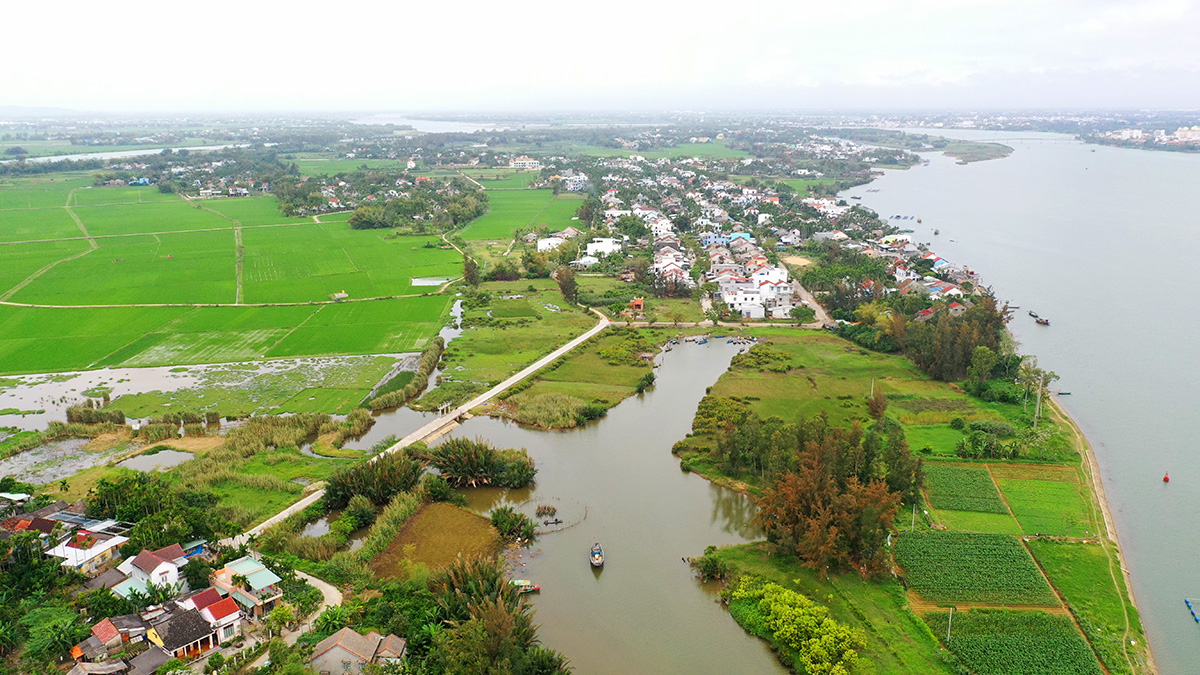
Aerial view of the Cam Kim area in Hoi An Ward - Photo: Quang Ngoc
The water wharf is not only a symbolic image of the Vietnamese countryside often described as “the banyan tree, the water wharf, and the communal yard,” but also represents a tangible blessing granted by nature to sustain the survival and development of communities, from Vietnamese populations in midland and delta regions to coastal and island residents, as well as ethnic minorities in mountainous areas.For this reason, water wharves are respected and regarded as sacred by communities everywhere, expressed through various forms of ritualization, particularly the annual early-spring ceremony of worshipping the water wharf.
Although referred to as early-spring worship, preparation for the ceremony begins earlier. In many lowland localities, preparations are made during the final days of the twelfth lunar month. In highland areas, many communities begin preparing rituals for worshipping water wharves or water troughs shortly after the bright full-moon night of the last month of the year.
The scale of these ceremonies varies by locality. However, highland communities generally preserve long-standing customs associated with spiritual beliefs regarding water sources and organize ceremonies on a relatively large scale, mobilizing broad community participation.
In the lowlands, when the drizzling rains of late year begin to subside and warm sunlight appears, villagers begin cleaning houses, clearing vegetation, cutting grass, and repairing roads. Among these activities, cleaning, clearing, and reinforcing the community water wharf is an indispensable task. The work is usually carried out by young men living near the wharf under the guidance of several elderly villagers.
On the final day of the lunar year, either the 30th or the 29th day of the twelfth month if it is a short month, villages organize the year-end ceremony at the water wharf. A square or round table covered with cloth and holding offerings is placed near the riverbank facing the wharf.
In wealthier localities, three tables may be arranged: the central table for river and land deities, with two additional tables on the left and right. Offerings typically include incense, candles, fruits, sweet soup, sticky rice, betel and areca, and rice wine. In prosperous places, a plate of boiled pork or a boiled young rooster may also be included.
The ceremony is conducted by elderly men in the village dressed in traditional long gowns and ceremonial headgear. After the year-end ritual is completed, all activities related to the water wharf are temporarily suspended until the ceremony to reopen the wharf at the beginning of the year, usually held on the morning of the third day of the Lunar New Year. During this period, villagers believe the wharf must remain undisturbed so that the river deities can celebrate the New Year in peace.
In the past, year-end water-wharf worship was a widespread custom among communities from mountainous to lowland areas of the Quảng region, especially in places where river wharves supported trading, fishing activities, or ferry crossings. Even at coastal landing sites where boats gathered or at bathing beaches, people organized year-end ceremonies to give thanks to sea deities for a year of livelihood and activities. Residents would also refrain from going out to sea or bathing during the first one to three days of the new year.
At the beginning of the new year, many localities in the Quảng region, from the upstream areas of Trà Linh to Cửa Đại estuary, organize rituals associated with water wharves.
In several communes and wards of what was formerly Hội An city, now part of Đà Nẵng city such as Cẩm Hà, Minh An, Cẩm Kim, and Cẩm Thanh, residents traditionally hold boat races known as “đảo thủy” at the beginning of the year. The phrase “đảo thủy” means praying for water, the source of life and livelihood for communities. Praying for water also means wishing for abundant water resources so that livelihoods prosper and wealth flows like water.
Boat racing for blessings at the beginning of the year is also organized at Trà Linh Wharf, where the shrine of Bà Chúa Ngọc is located. At Được market in Bình Triều commune, Thăng Bình district of Quảng Nam, now part of Thăng An commune of Đà Nẵng city, residents organize a procession of Lady Bà’s palanquin accompanied by boat racing to pray for favorable weather and prosperous trade during the new year. This takes place at the river wharf in front of the market on the eleventh day of the first lunar month each year.
There are likely many more lowland localities in the Quảng region that practice rituals related to the sacralization of water wharves, a crucial factor for the survival and livelihood of communities. With broader and deeper research, more valuable and interesting information could be discovered to better understand the role of water wharves in both the material and spiritual life of local people.
Closely related to the indispensable role of water in community life and spiritual beliefs in the blessings granted by forest, tree, and water deities, many highland ethnic groups in the Quảng region such as the Cor, Ca Dong, and Cơ Tu practice the ritual of worshipping water troughs at the beginning of the year.
This ritual is an important tradition among many highland ethnic groups in the Quảng region. While sharing similarities with the early-year water-wharf worship of the Kinh people, it is usually organized on a larger scale, involving large numbers of villagers (Vell, Plei, Plơi) and featuring ritual practices that strongly reflect primordial beliefs regarding water sources.
A prominent example is the water trough worship ceremony of the Ca Dong people in the former districts of Nam Trà My and Bắc Trà My, now including communes such as Trà Giáp, Trà Dốc, Trà Mi, Trà Tập, Trà Vân, and Trà Leng in Đà Nẵng city.
The ceremony is held after the harvest season and lasts for three days and three nights, attracting the participation of the entire community. Prior to the ceremony, the village head mobilizes villagers to clear vegetation, clean, and repair the water trough system from the source and along its channels.
On the first day, the village head and ritual specialists perform ceremonies at the water trough. On the second day, rituals take place at individual households’ roofs. On the third day, a communal ceremony is held at the house of the village elder or village head.
Along with expressing gratitude to deities for providing water resources and praying for favorable weather, peace, and prosperity in the new year, the water trough worship ceremony is also an occasion for villagers to gather, celebrate, sing traditional songs, perform gong music, prepare special foods for offerings, and share them together. Through these activities, community solidarity is strengthened and villagers cooperate in managing communal affairs.
The water trough worship ceremony of the Ca Dong people, and of ethnic minority communities in the western region of Đà Nẵng more broadly, represents an intangible cultural heritage in the category of social practices and beliefs. It holds significant cultural value and should continue to be researched, documented, and proposed for recognition as a National Intangible Cultural Heritage.
The water-wharf worship ceremony of lowland communities and the water-trough worship ceremony of ethnic minority communities in mountainous areas are long-standing rituals associated with water worship, reflecting reverence for water sources as the essential factor sustaining life and forming communities in the Quảng region in particular and across the country in general.
Besides expressing gratitude to nature and preserving collective memory and community traditions, these rituals also serve as effective measures for protecting the natural ecological environment, especially the protection of clean water sources, the lifeline of communities.
Author: Trần Văn An
Newer articles
Older articles