Wood Carving Techniques and Tools in Hội An
- Thursday - 28/05/2026 05:31
- Close page
In the book Nguyễn Art, researcher Nguyễn Hữu Thông remarks: “A wooden house cannot fully express its intended beauty if its interior is not ‘clothed’ in carving, inlay, or even lacquer painting and gilding[1].” This is clearly evident when visiting the old wooden houses in Hội An Ancient Town. It can be said that woodcarvers in Hội An have played a highly important role in beautifying the locality’s wooden architectural works.
In addition to mastering the fundamental stages and processes required to create a complete carved wooden product, craftsmen must also be proficient in carving techniques and the use of carving tools. This article introduces the basic carving techniques and several chiseling tools used by artisans in Hội An.
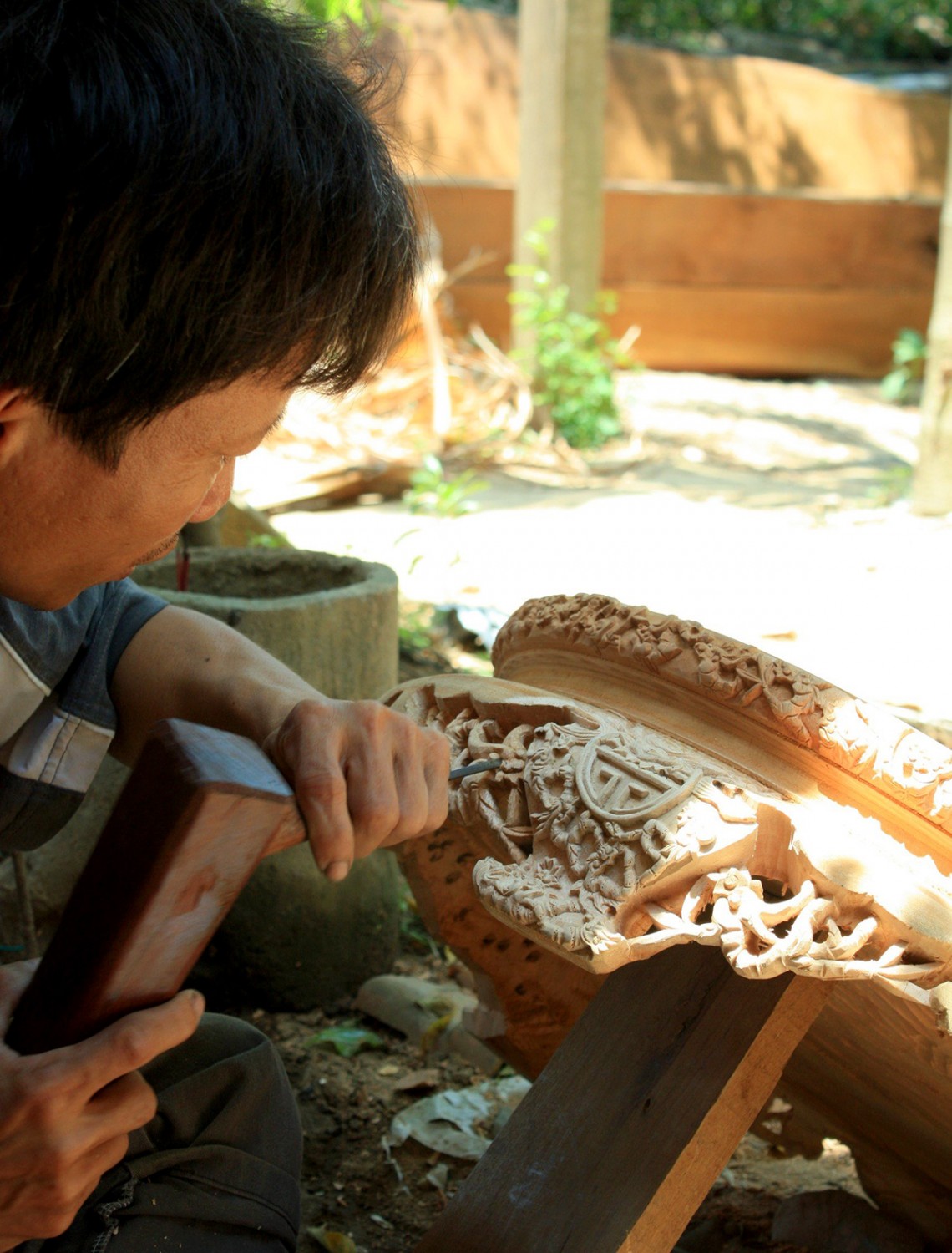
An artisan from Kim Bồng Carpentry Village is skillfully carving intricate patterns into wood. Photo by Hoang Phuc
Basic carving techniques: According to woodcarvers in Hội An, there are four main carving (chiseling) techniques:
- Pressed carving (chạm bấm, incised carving): carving details downward into a flat wooden surface, with decorative elements recessed below the background.
- Raised carving (chạm nổi, relief carving): carving details so that they stand out on a flat wooden surface, while lowering the surrounding background without piercing through it.
- Pierced carving (chạm lủng, chạm thủng, openwork carving): cutting completely through a wooden panel to create forms. The motifs are brought into relief while the background is removed, allowing one to see through the piece, much like a decorative ventilation screen.
- Open relief carving (chạm lộng, chạm khơi, three-dimensional carving): carving forms in multiple layers and depths, with foreground and background elements, while still maintaining their connection to the main base. Some parts remain attached to the base, while others are released from the surface, creating a highly vivid three-dimensional effect.
A single object may combine several carving techniques to achieve a high level of aesthetic refinement. Through consultation of various sources, it can be seen that the terminology used in Hội An differs somewhat from that of other localities in Vietnam, even when referring to the same carving methods.
In the carving process, craftsmen explain that the degree of complexity generally increases in the following order: pressed carving, pierced carving, raised carving, and open relief carving. Among these, background lowering in relief carving and open relief carving are considered the most difficult. Open relief carving is regarded as the most challenging of all because the details are often small and highly intricate, requiring considerable skill. In the past, raised carving took the most time because of the need to lower and finish the background to the required standard. Hand-lowering the background to achieve an even, smooth surface was a particularly demanding and labor-intensive task. If done poorly, the surface would become uneven and rough. For this reason, apprentices traditionally learned pressed carving first, then raised carving (to master background treatment and detail work similar to pressed carving), before progressing to pierced carving and finally open relief carving. Today, machinery is used to assist with background lowering, making the process faster, easier, and much more refined.
There are also several related technical terms. Open relief carving (khơi) has two forms: single-layer openwork (khơi đơn), which consists of one carved layer, and double or multi-layer openwork (khơi kép), which consists of two or more layers. In the carving of Chinese characters on horizontal lacquered boards (hoành phi) and parallel couplets (liễn đối), there are also two descriptive terms for carving styles: “upturned bean-shell” carving (vỏ đậu ngửa), in which the craftsman uses a curved gouge to carve the entire character into a concave form resembling an upturned bean shell; and “inverted bean-shell” carving (vỏ đậu úp), in which the craftsman uses a V-chisel or a cổ cò parting chisel to outline the character, then uses a flat chisel to hollow the interior into a curved recessed form, making the stroke resemble an overturned bean shell.
In the carving process, craftsmen explain that the degree of complexity generally increases in the following order: pressed carving, pierced carving, raised carving, and open relief carving. Among these, background lowering in relief carving and open relief carving are considered the most difficult. Open relief carving is regarded as the most challenging of all because the details are often small and highly intricate, requiring considerable skill. In the past, raised carving took the most time because of the need to lower and finish the background to the required standard. Hand-lowering the background to achieve an even, smooth surface was a particularly demanding and labor-intensive task. If done poorly, the surface would become uneven and rough. For this reason, apprentices traditionally learned pressed carving first, then raised carving (to master background treatment and detail work similar to pressed carving), before progressing to pierced carving and finally open relief carving. Today, machinery is used to assist with background lowering, making the process faster, easier, and much more refined.
There are also several related technical terms. Open relief carving (khơi) has two forms: single-layer openwork (khơi đơn), which consists of one carved layer, and double or multi-layer openwork (khơi kép), which consists of two or more layers. In the carving of Chinese characters on horizontal lacquered boards (hoành phi) and parallel couplets (liễn đối), there are also two descriptive terms for carving styles: “upturned bean-shell” carving (vỏ đậu ngửa), in which the craftsman uses a curved gouge to carve the entire character into a concave form resembling an upturned bean shell; and “inverted bean-shell” carving (vỏ đậu úp), in which the craftsman uses a V-chisel or a cổ cò parting chisel to outline the character, then uses a flat chisel to hollow the interior into a curved recessed form, making the stroke resemble an overturned bean shell.
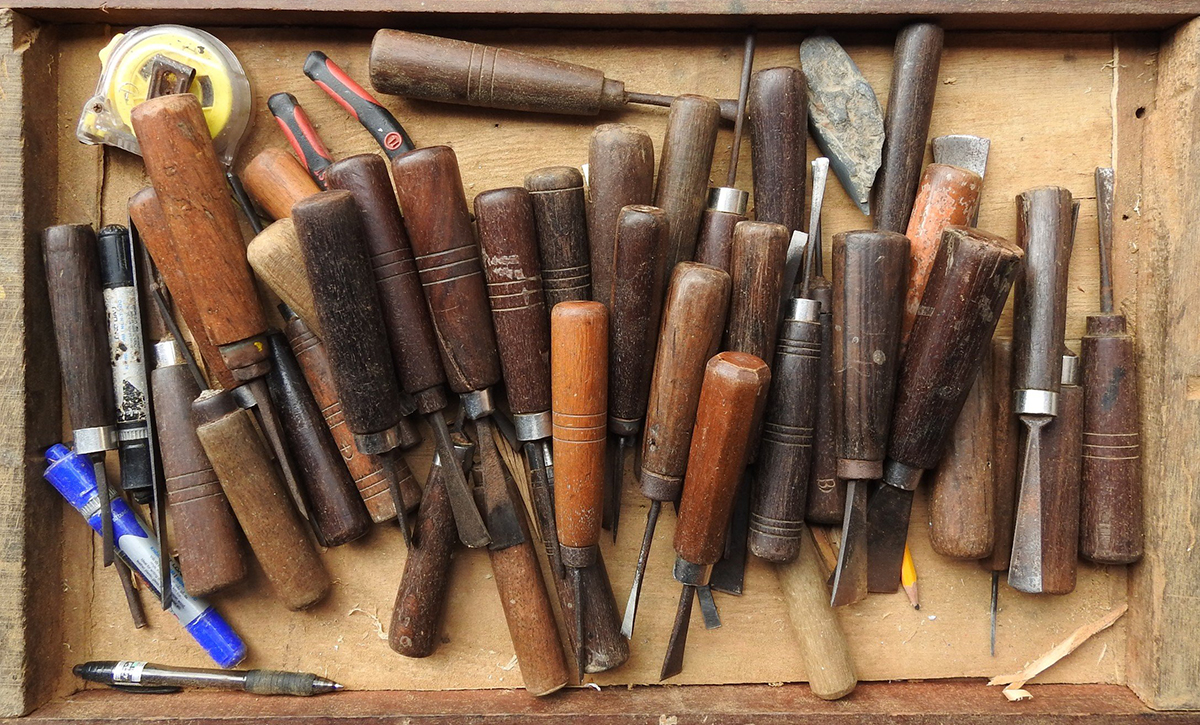
Wood carving tools - Photo by Hoàng Phúc.
Carving tools used for wood ornamentation: The chisel is the primary tool used in woodcarving. The main types include:
- Parting or detailing chisel (đục tách, đục tỉa, V-chisel): the blade is V-shaped. It includes a rounded V (V núc), in which the V-angle is softly rounded, and a straight V (V thẳng), in which the angle is sharp. These are used for incising, marking out volumes according to the drawn design, and defining carved lines. Small V-chisels are used for fine line separation, while larger ones are used for rough shaping.
- Curved gouge (đục dủm, đục móng): the blade curves like a flower petal. It may be beveled on the inner side or outer side depending on which edge is sharpened. There are round gouges (dủm tròn), which form a true semicircle, and flat gouges (dủm bẹt), which have a shallower curved profile. These are used for carving flower petals, leaves, and similar motifs.
- Flat chisel (đục lá): a straight-edged chisel used for carving straight lines and geometric motifs such as T-patterns and Buddhist swastika motifs.
- Stork-neck parting chisel (chàng tách cổ cò, also called chàng chạm, chàng cổ cò, chàng tách): a chisel shaped somewhat like a stork’s neck, made in only one general form and size. It has many applications and can be used very flexibly in place of several other chisels, producing lines of different widths and effects. However, it requires a high level of craftsmanship to use effectively.
Each type of chisel comes in multiple sizes, and the number of tools depends on the needs of each artisan. The appropriate chisel is chosen according to the position and detail being worked, although the V-chisel is the most commonly used. The V-chisel separates lines very quickly, but produces shallow and relatively uniform carved lines, lacking flexibility. It cannot easily create irregular thick-thin strokes or the softness that the stork-neck parting chisel can achieve. The chàng tách produces deeper cuts and is used in areas requiring sharpness and expressive detail. It allows the craftsman’s intent to come through more clearly and is often used for carving Chinese characters on couplets or incising small characters on spirit tablets.
Before the 1990s, artisans of Kim Bồng carpentry village mainly used the chàng tách, while V-chisels were only introduced later from northern craft villages. The chàng tách is not exclusive to Kim Bồng carpentry, but in the past it helped define the village’s distinctive reputation, because although other woodworking villages also used it, none relied on it as extensively as Kim Bồng, where many others preferred the V-chisel instead.
Although highly versatile, the chàng tách is difficult to use and takes longer to work with than the V-chisel. It is labor-intensive, which increases the cost of the finished product. Craftsmen must train for a considerable period before they can handle it fluently and gracefully. Once they become familiar with it, and understand its characteristics, they often go to a local blacksmith to commission one with the specific curve that best suits their hand. For this reason, it can be said to be a very important tool for carvers. A craftsman who has learned to use the chàng tách but leaves it unused for some time often finds it difficult to return to, because the hand becomes “stiff” and loses flexibility. Regular practice is therefore essential.
Young craftsmen today are still taught how to use the chàng tách during their apprenticeship, but in actual practice they use it very little, if at all, relying instead on the V-chisel. At the workshop of artisan Huỳnh Sướng, younger workers are still trained to use the chàng tách in the hope of preserving the identity of Kim Bồng carpentry. However, through field research, it appears that although many carvers trained in the Huỳnh Sướng workshop still keep a chàng tách in their toolbox and know how to use it, they have long since stopped using it regularly. A similar situation can be observed in other woodworking villages in Hội An: the chàng tách still exists as a tool, but its use has gradually declined.
Another essential tool is the carving mallet (dùi đục). There are also several supporting tools, such as the punch (đột), used to create small holes or dotted textures on surfaces, for example the seeds of fruits or tiny thorns on lotus stems; and the scraper (nạo), used to clean the background surface, smooth pierced areas, or refine the surface of carved details to create a more polished finish.
Today, woodcarvers are greatly assisted by machinery, which reduces labor, speeds up production, and lowers the cost of products. Such tools include hole-cutting machines for piercing work, handheld carving machines with a variety of router bits, and highly applicable technologies such as CNC cutting and 3D carving machines. Machines can produce large numbers of nearly identical products with high sharpness and precision. However, such products often lack uniqueness and do not convey the spirit or individual expressive quality of the artisan in the same way that handcrafted works made by traditional methods do.
Woodcarving requires artisans to use tools skillfully and apply techniques flexibly in order to achieve the desired results. Each carving tool has a different shape and size and therefore requires specific handling techniques, along with the artisan’s ability to control it in order to produce accurate, even, and aesthetically pleasing carved lines without damaging the wood. For this reason, a carver must spend many years practicing in order to develop proficiency in using tools and applying carving techniques.
The adoption of modern technology and machinery as support is certainly necessary. However, the reduced use of traditional tools such as the stork-neck parting chisel, which once contributed significantly to the distinctive identity of the craft village, is somewhat regrettable. Alongside efforts to preserve the village craft tradition, it is hoped that the artisans and woodworkers of Kim Bồng will continue to maintain and strengthen the use of traditional carving techniques and tools so that their products may become even more refined and distinctive, leaving a lasting impression on customers and visitors alike.
Before the 1990s, artisans of Kim Bồng carpentry village mainly used the chàng tách, while V-chisels were only introduced later from northern craft villages. The chàng tách is not exclusive to Kim Bồng carpentry, but in the past it helped define the village’s distinctive reputation, because although other woodworking villages also used it, none relied on it as extensively as Kim Bồng, where many others preferred the V-chisel instead.
Although highly versatile, the chàng tách is difficult to use and takes longer to work with than the V-chisel. It is labor-intensive, which increases the cost of the finished product. Craftsmen must train for a considerable period before they can handle it fluently and gracefully. Once they become familiar with it, and understand its characteristics, they often go to a local blacksmith to commission one with the specific curve that best suits their hand. For this reason, it can be said to be a very important tool for carvers. A craftsman who has learned to use the chàng tách but leaves it unused for some time often finds it difficult to return to, because the hand becomes “stiff” and loses flexibility. Regular practice is therefore essential.
Young craftsmen today are still taught how to use the chàng tách during their apprenticeship, but in actual practice they use it very little, if at all, relying instead on the V-chisel. At the workshop of artisan Huỳnh Sướng, younger workers are still trained to use the chàng tách in the hope of preserving the identity of Kim Bồng carpentry. However, through field research, it appears that although many carvers trained in the Huỳnh Sướng workshop still keep a chàng tách in their toolbox and know how to use it, they have long since stopped using it regularly. A similar situation can be observed in other woodworking villages in Hội An: the chàng tách still exists as a tool, but its use has gradually declined.
Another essential tool is the carving mallet (dùi đục). There are also several supporting tools, such as the punch (đột), used to create small holes or dotted textures on surfaces, for example the seeds of fruits or tiny thorns on lotus stems; and the scraper (nạo), used to clean the background surface, smooth pierced areas, or refine the surface of carved details to create a more polished finish.
Today, woodcarvers are greatly assisted by machinery, which reduces labor, speeds up production, and lowers the cost of products. Such tools include hole-cutting machines for piercing work, handheld carving machines with a variety of router bits, and highly applicable technologies such as CNC cutting and 3D carving machines. Machines can produce large numbers of nearly identical products with high sharpness and precision. However, such products often lack uniqueness and do not convey the spirit or individual expressive quality of the artisan in the same way that handcrafted works made by traditional methods do.
Woodcarving requires artisans to use tools skillfully and apply techniques flexibly in order to achieve the desired results. Each carving tool has a different shape and size and therefore requires specific handling techniques, along with the artisan’s ability to control it in order to produce accurate, even, and aesthetically pleasing carved lines without damaging the wood. For this reason, a carver must spend many years practicing in order to develop proficiency in using tools and applying carving techniques.
The adoption of modern technology and machinery as support is certainly necessary. However, the reduced use of traditional tools such as the stork-neck parting chisel, which once contributed significantly to the distinctive identity of the craft village, is somewhat regrettable. Alongside efforts to preserve the village craft tradition, it is hoped that the artisans and woodworkers of Kim Bồng will continue to maintain and strengthen the use of traditional carving techniques and tools so that their products may become even more refined and distinctive, leaving a lasting impression on customers and visitors alike.