Distinctive and Unique Features of the Cẩm Thanh Bamboo-and-Nipa-Palm House-Building Craft
- Monday - 14/09/2026 22:40
- Close page
The nipa palm forest in Cẩm Thanh is a particularly important form of local resource in terms of history, culture, ecology, and scenic value. Through ingenuity and practical knowledge, local residents have made use of nipa palm leaves and the abundant supply of bamboo as materials for building houses, producing household items, and later creating souvenirs and handicrafts of commercial value.
From this, the traditional craft of building bamboo-and-nipa houses, distinctive to the locality, gradually took shape. This craft is a clear demonstration of human adaptation to the natural environment: knowing how to utilize available resources, creatively turning them into products that directly serve everyday needs, and generating income to support life. In recent years, with the development of tourism, local people have further taken advantage of these natural resources for tourism purposes, including ecotourism, nipa forest tours, and demonstrations of the bamboo-and-nipa craft. These activities and products have become highly attractive features for visitors coming to Hội An.
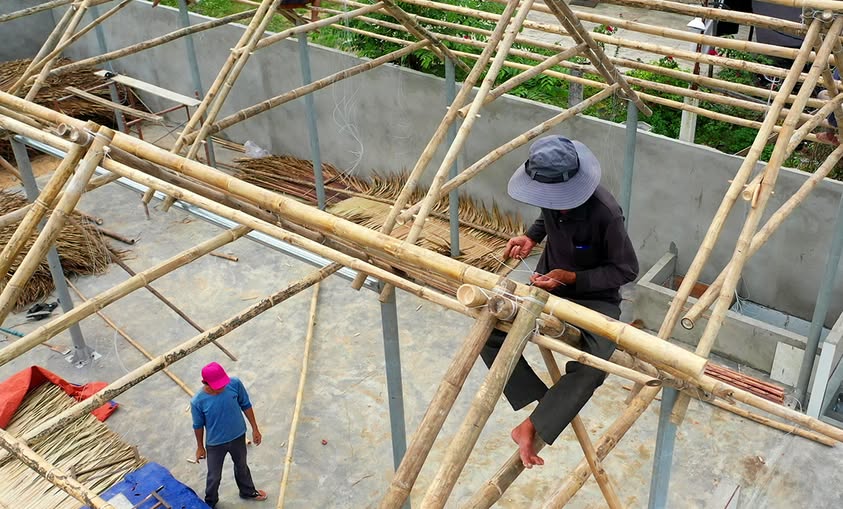
According to community consultation, the Cẩm Thanh bamboo-and-nipa craft includes more than twenty-four different products made specifically for house construction and assembly. These include nipa roofing panels, bamboo ceiling cladding, bamboo pillar coverings, bamboo flutes or hollow bamboo tubes used in structural or decorative applications, thatch panels, woven nipa leaves, composite blinds, bamboo gutters, windows, prop-up shutters, partition screens, and other related components.
The building of bamboo-and-nipa houses relies primarily on manual methods. Very little modern machinery is used in the process, and no chemical substances are employed in the treatment or preservation of raw materials. The craftsmen work mainly from experience. Knowledge is passed from one generation to the next, allowing the craft to be maintained and further developed while ensuring that the resulting products remain durable and of good quality. The joining of structural members and other house components is done entirely with rattan ties or nylon cord, materials that possess strong mechanical durability and provide a very high degree of firmness. This traditional joining technique allows the structures to withstand the powerful winds typical of the central coastal region, an area frequently affected by annual storms and flooding.
A traditional bamboo-and-nipa house, whether built in a three-bay or five-bay form, with or without side wings, is generally composed of several essential parts: a load-bearing frame made of bamboo, including columns, rafters, beams, purlins, and ridge elements, along with the enclosing system consisting of the roof, wall screens, and doors, all erected on a raised earthen platform. To construct a complete house, the processing and preparation of raw materials is extremely important. This stage requires the craftsman to possess an intimate and internalized understanding of the structural logic of a traditional bamboo-and-nipa house, including its required scale, the proper height of the foundation in relation to surrounding ground level, and the suitability of each material for each part of the structure. Bamboo must be chosen appropriately for columns, rafters, purlins, and ridge members, while nipa must be selected according to whether it will be used for roofing sheets, wall panels, or doors. This is not merely a matter of technical skill, but also a rich body of knowledge accumulated by craftsmen and the wider community over several hundred years of practice.
In earlier times, houses were basically erected in the form of three bays, two side aisles, and one kitchen. Over time, however, craftsmen began experimenting and developing a much wider variety of forms in order to meet market demand. Today, local artisans are capable of building many different types of structures, including Rông houses, Gươl houses, stilt houses modeled on those of various ethnic groups, Thai-style roofed structures, bungalows, parasol-like shelters made from bamboo and nipa, and other architectural forms. The village craftsmen are able to execute all of these, depending on the customer’s needs and intended use.
To build a bamboo-and-nipa house, local people must combine nipa palm with a number of other materials, particularly bamboo and rattan. Nipa is used for wall panels, doors, and roofing. Bamboo serves as the main structural framework, forming the columns, rafters, purlins, and ridge members. Rattan and nylon cord are used as tying materials for securing the frame, fastening woven wall panels, attaching roofing, and binding other structural and finishing components. All of these materials are selected carefully and meticulously to ensure that the final product is of high quality and appropriate for each specific part of the house.
Nipa itself is processed into many different forms. Whole nipa fronds may be split in half, dried, and soaked thoroughly for use in ridge-thatching. Leaves can be stripped and woven into roofing sheets, doors, blinds, decorative panels, or screening elements. The midribs of nipa fronds may be split and dried to make woven panels, pillar cladding, or ceiling lining. To ensure the durability of the building materials, soaking both nipa and bamboo in water and mud is considered the optimal technique. This treatment helps protect the materials from termites and other insects. In the case of nipa in particular, once it has been properly soaked, it also performs better during the rainy season, as it is less likely to absorb moisture outwardly, helping to keep the roof, wall panels, and partitions dry.
Because central Vietnam is characterized by a harsh climate, with frequent heat, rain, wind, and storms, the construction of houses, especially bamboo-and-nipa houses, must be carefully calculated. This begins with the design stage and continues through the selection of materials for each individual component, all of which must be appropriate before fabrication begins. The goal is always to ensure structural durability, stability, and good load-bearing capacity. The techniques for laying thatch, making roofing sheets, decorative partitions, shutters, windows, and panel doors are all highly varied and sophisticated.
What began as a very simple form of rough leaf covering, known locally as “lợp nợm,” gradually evolved through the creativity of the craftsmen into proper nipa-leaf roofing sheets for houses, with high durability and strong resistance to leaks during the rainy season. Wall panels and partitions also became more varied and refined. Drawing from the same basic principle of “lợp nợm,” craftsmen began arranging nipa leaves into large panels in a way similar to roof-thatching, creating substantial outer screens for the exterior of the house. Interior partitions are often made from nipa midribs and may consist of one layer or two layers of midribs, or a combination of one leaf layer with one midrib layer. In some cases, the nipa elements are arranged in opposing directions to create different structural or visual effects.
The load-bearing structure of the nipa house is formed by the columns, rafters, purlins, and related framing members. Bamboo is the primary material used for this structural skeleton. The columns, rafters, purlins, and ridge members are connected by bamboo pegs, locally known as con sẻ, and then tied securely with rattan or nylon cord. Because the frame is the main structural system of the house, selecting the right bamboo is crucial. The bamboo used for ridge beams, purlins, and rafters must be mature, thick-walled, strong, and straight, and it must also have been soaked for the proper amount of time, usually more than one year, in order to meet construction requirements.
Traditional bamboo-and-thatch houses usually do not have a fixed permanent eave. Instead, they use a system of prop-up shutters, which are made from bamboo and covered with nipa leaves. When these shutters are propped open, they function as eaves or awnings; when lowered, they become solid closing panels that act as doors. This is a highly practical design. The window system is similarly covered by smaller prop-up shutters built according to the same principle. During the rainy season, these shutters can still be propped open at a slanted angle that allows rainwater to run off easily.
At present, many of the establishments engaged in the bamboo-and-nipa house-building trade have also expanded strongly into the production of bamboo handicrafts. Through their creativity, local craftsmen have made use of available materials to create a wide range of bamboo craft products such as tables, chairs, cabinets, beds, cups, and other household or decorative items. Initially, these were made only for family use. However, as tourism developed, some workshops invested in equipment and built more specialized production models focused on handicrafts. Examples include the workshops of Võ Tấn Tân, Huỳnh Phước Đức, and Phan Mót. The results have been very positive, adding another line of craft products to serve visitors to the craft village. These handicraft products are highly diverse and abundant. According to survey data, there are currently around forty different types of such products.
From its origins as a practical means of making temporary shelter, the technique of bamboo-and-nipa house building in Cẩm Thanh has now developed significantly in terms of form, design, and aesthetics. A great deal of experience has been accumulated over time, giving rise to a distinctive local identity. Today, houses made from bamboo and nipa are no longer valued only for their practical use as ordinary dwellings. They also carry aesthetic value and are widely used as decorative or architectural features in ecotourism sites, high-end coastal resorts, villas, homestays, cafés, and refreshment stalls.
The Cẩm Thanh nipa-house brand has been officially recognized and certified by the Intellectual Property Office. The creativity of the craftsmen has brought new vitality to the bamboo-and-nipa house-building craft today. Orders are increasingly coming in from many different places. This is a very encouraging sign for the future of this traditional craft village, as it helps stimulate the local economy and provides a more stable source of income for local residents.
On 21 February 2024, the Ministry of Culture, Sports and Tourism issued Decision No. 380/QĐ-BVHTTDL announcing the National Intangible Cultural Heritage List, in which the craft of building bamboo-and-nipa houses in Cẩm Thanh, Hội An City, Quảng Nam Province, was officially inscribed under the category of Traditional Craftsmanship.
According to community consultation, the Cẩm Thanh bamboo-and-nipa craft includes more than twenty-four different products made specifically for house construction and assembly. These include nipa roofing panels, bamboo ceiling cladding, bamboo pillar coverings, bamboo flutes or hollow bamboo tubes used in structural or decorative applications, thatch panels, woven nipa leaves, composite blinds, bamboo gutters, windows, prop-up shutters, partition screens, and other related components.
The building of bamboo-and-nipa houses relies primarily on manual methods. Very little modern machinery is used in the process, and no chemical substances are employed in the treatment or preservation of raw materials. The craftsmen work mainly from experience. Knowledge is passed from one generation to the next, allowing the craft to be maintained and further developed while ensuring that the resulting products remain durable and of good quality. The joining of structural members and other house components is done entirely with rattan ties or nylon cord, materials that possess strong mechanical durability and provide a very high degree of firmness. This traditional joining technique allows the structures to withstand the powerful winds typical of the central coastal region, an area frequently affected by annual storms and flooding.
A traditional bamboo-and-nipa house, whether built in a three-bay or five-bay form, with or without side wings, is generally composed of several essential parts: a load-bearing frame made of bamboo, including columns, rafters, beams, purlins, and ridge elements, along with the enclosing system consisting of the roof, wall screens, and doors, all erected on a raised earthen platform. To construct a complete house, the processing and preparation of raw materials is extremely important. This stage requires the craftsman to possess an intimate and internalized understanding of the structural logic of a traditional bamboo-and-nipa house, including its required scale, the proper height of the foundation in relation to surrounding ground level, and the suitability of each material for each part of the structure. Bamboo must be chosen appropriately for columns, rafters, purlins, and ridge members, while nipa must be selected according to whether it will be used for roofing sheets, wall panels, or doors. This is not merely a matter of technical skill, but also a rich body of knowledge accumulated by craftsmen and the wider community over several hundred years of practice.
In earlier times, houses were basically erected in the form of three bays, two side aisles, and one kitchen. Over time, however, craftsmen began experimenting and developing a much wider variety of forms in order to meet market demand. Today, local artisans are capable of building many different types of structures, including Rông houses, Gươl houses, stilt houses modeled on those of various ethnic groups, Thai-style roofed structures, bungalows, parasol-like shelters made from bamboo and nipa, and other architectural forms. The village craftsmen are able to execute all of these, depending on the customer’s needs and intended use.
To build a bamboo-and-nipa house, local people must combine nipa palm with a number of other materials, particularly bamboo and rattan. Nipa is used for wall panels, doors, and roofing. Bamboo serves as the main structural framework, forming the columns, rafters, purlins, and ridge members. Rattan and nylon cord are used as tying materials for securing the frame, fastening woven wall panels, attaching roofing, and binding other structural and finishing components. All of these materials are selected carefully and meticulously to ensure that the final product is of high quality and appropriate for each specific part of the house.
Nipa itself is processed into many different forms. Whole nipa fronds may be split in half, dried, and soaked thoroughly for use in ridge-thatching. Leaves can be stripped and woven into roofing sheets, doors, blinds, decorative panels, or screening elements. The midribs of nipa fronds may be split and dried to make woven panels, pillar cladding, or ceiling lining. To ensure the durability of the building materials, soaking both nipa and bamboo in water and mud is considered the optimal technique. This treatment helps protect the materials from termites and other insects. In the case of nipa in particular, once it has been properly soaked, it also performs better during the rainy season, as it is less likely to absorb moisture outwardly, helping to keep the roof, wall panels, and partitions dry.
Because central Vietnam is characterized by a harsh climate, with frequent heat, rain, wind, and storms, the construction of houses, especially bamboo-and-nipa houses, must be carefully calculated. This begins with the design stage and continues through the selection of materials for each individual component, all of which must be appropriate before fabrication begins. The goal is always to ensure structural durability, stability, and good load-bearing capacity. The techniques for laying thatch, making roofing sheets, decorative partitions, shutters, windows, and panel doors are all highly varied and sophisticated.
What began as a very simple form of rough leaf covering, known locally as “lợp nợm,” gradually evolved through the creativity of the craftsmen into proper nipa-leaf roofing sheets for houses, with high durability and strong resistance to leaks during the rainy season. Wall panels and partitions also became more varied and refined. Drawing from the same basic principle of “lợp nợm,” craftsmen began arranging nipa leaves into large panels in a way similar to roof-thatching, creating substantial outer screens for the exterior of the house. Interior partitions are often made from nipa midribs and may consist of one layer or two layers of midribs, or a combination of one leaf layer with one midrib layer. In some cases, the nipa elements are arranged in opposing directions to create different structural or visual effects.
The load-bearing structure of the nipa house is formed by the columns, rafters, purlins, and related framing members. Bamboo is the primary material used for this structural skeleton. The columns, rafters, purlins, and ridge members are connected by bamboo pegs, locally known as con sẻ, and then tied securely with rattan or nylon cord. Because the frame is the main structural system of the house, selecting the right bamboo is crucial. The bamboo used for ridge beams, purlins, and rafters must be mature, thick-walled, strong, and straight, and it must also have been soaked for the proper amount of time, usually more than one year, in order to meet construction requirements.
Traditional bamboo-and-thatch houses usually do not have a fixed permanent eave. Instead, they use a system of prop-up shutters, which are made from bamboo and covered with nipa leaves. When these shutters are propped open, they function as eaves or awnings; when lowered, they become solid closing panels that act as doors. This is a highly practical design. The window system is similarly covered by smaller prop-up shutters built according to the same principle. During the rainy season, these shutters can still be propped open at a slanted angle that allows rainwater to run off easily.
At present, many of the establishments engaged in the bamboo-and-nipa house-building trade have also expanded strongly into the production of bamboo handicrafts. Through their creativity, local craftsmen have made use of available materials to create a wide range of bamboo craft products such as tables, chairs, cabinets, beds, cups, and other household or decorative items. Initially, these were made only for family use. However, as tourism developed, some workshops invested in equipment and built more specialized production models focused on handicrafts. Examples include the workshops of Võ Tấn Tân, Huỳnh Phước Đức, and Phan Mót. The results have been very positive, adding another line of craft products to serve visitors to the craft village. These handicraft products are highly diverse and abundant. According to survey data, there are currently around forty different types of such products.
From its origins as a practical means of making temporary shelter, the technique of bamboo-and-nipa house building in Cẩm Thanh has now developed significantly in terms of form, design, and aesthetics. A great deal of experience has been accumulated over time, giving rise to a distinctive local identity. Today, houses made from bamboo and nipa are no longer valued only for their practical use as ordinary dwellings. They also carry aesthetic value and are widely used as decorative or architectural features in ecotourism sites, high-end coastal resorts, villas, homestays, cafés, and refreshment stalls.
The Cẩm Thanh nipa-house brand has been officially recognized and certified by the Intellectual Property Office. The creativity of the craftsmen has brought new vitality to the bamboo-and-nipa house-building craft today. Orders are increasingly coming in from many different places. This is a very encouraging sign for the future of this traditional craft village, as it helps stimulate the local economy and provides a more stable source of income for local residents.
On 21 February 2024, the Ministry of Culture, Sports and Tourism issued Decision No. 380/QĐ-BVHTTDL announcing the National Intangible Cultural Heritage List, in which the craft of building bamboo-and-nipa houses in Cẩm Thanh, Hội An City, Quảng Nam Province, was officially inscribed under the category of Traditional Craftsmanship.